
 800-887-7299
70+ Cancers Are Known as 9/11-Related. Proving You Were There Is the Hard Part.

After a cancer diagnosis, someone who worked, lived, attended school, or responded in an area affected by September 11 may wonder: How can I prove that something I was exposed to years ago caused my illness?
For cancers recognized by the World Trade Center Health Program, you do not have to start from scratch establishing the scientific basis for coverage. The federal government has already evaluated that evidence and recognized covered cancers through its review and rulemaking process. What remains is establishing your qualifying exposure and obtaining certification of your particular condition.
That distinction matters. Knowing you were there and having a covered diagnosis are not the same as having an approved application. At Hansen & Rosasco, LLP, we help clients with the demanding work of documenting their exposure, supporting their Health Program applications, and pursuing the benefits available to them.
How Does Proving Causation Work in 9/11 Claims?
An important foundation was laid in 2012, when Dr. John Howard, then Director of the National Institute for Occupational Safety and Health and Administrator of the WTC Health Program, reviewed the scientific evidence, including research on cancer-causing substances in the World Trade Center dust and smoke, and determined that dozens of cancers should be added to the Program’s list of WTC-related health conditions. His findings and determination were incorporated into the federal final rule published on September 12, 2012. That decision established cancer coverage for eligible responders and survivors, subject to individual certification.
For applicants, the practical significance is that the scientific basis for recognizing these cancers does not have to be established anew in every application. The work instead centers on whether the individual’s condition and exposure meet the Program’s certification standards. The standard does not require 9/11 to be the only cause. Qualifying exposure must be “substantially likely to be a significant factor in aggravating, contributing to, or causing” the condition.
Two separate federal programs are involved. The WTC Health Program provides medical monitoring and treatment for certified conditions. The September 11th Victim Compensation Fund, or VCF, provides financial compensation to eligible claimants. The programs have different geographic boundaries, exposure periods, and eligibility requirements. Acceptance by one does not automatically establish eligibility for the other.
Why Proof of Presence Is So Important
Proving presence requires more than explaining that you were in Lower Manhattan after the attacks. Supporting evidence must establish that your experience meets the applicable eligibility requirements. Those requirements differ among eligible groups, and the Health Program and VCF do not apply identical standards. A cancer diagnosis cannot substitute for the required presence evidence.
Decades later, obtaining that evidence can be difficult. An employer may no longer exist. Old records may have been discarded. Former coworkers may be difficult to locate. Someone who attended school in the affected area as a child may have little documentation of their own. Missing records can leave a person with a genuine exposure history unsure how that history can be established.
These documentation problems are not minor administrative details. The WTC Health Program identifies incomplete or insufficient supporting documentation as the leading reason for application-processing delays. Even someone with a potentially covered illness can face a stalled application when the necessary evidence is missing. A suspension for missing evidence is not a denial, but it still delays the review.
Our firm helps clients address these difficulties rather than leaving them to reconstruct decades-old circumstances alone. That assistance includes working through gaps in available records and developing the supporting evidence needed for a meaningful review.
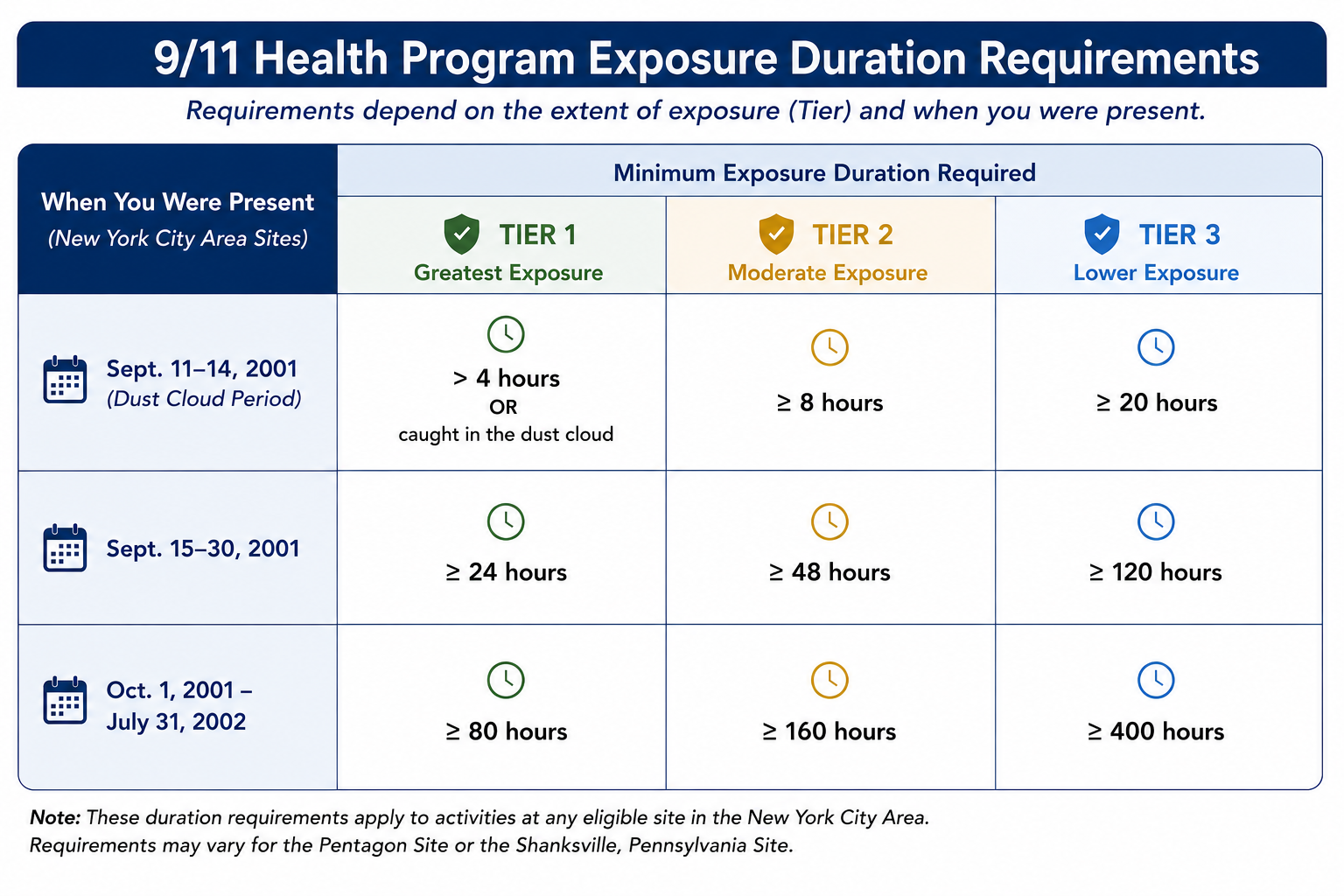
Duration and Intensity: The Other Part of Proving Exposure
Establishing that you were present is only part of the picture. How long you were exposed, and the nature and intensity of that exposure, also matter.
There are two related but distinct questions: whether your experience satisfies the requirements for enrollment in the Health Program, and whether your exposure supports certification of a particular illness. Meeting an enrollment requirement does not, by itself, resolve the separate medical-certification review. Dr. Howard’s February 20, 2015 certification policy addresses this review by requiring consideration of the location, intensity, and duration of exposure.
This is why a general statement that someone “worked downtown” may not resolve the issues the Program must evaluate. A person may establish presence for VCF purposes yet still need to satisfy the Health Program’s separate exposure and certification requirements. The details must be accurately understood and supported, rather than assumed from an address or a diagnosis alone.
At Hansen & Rosasco, we help clients connect their actual exposure history with the requirements that apply to their circumstances. Our work is to help ensure that the available evidence presents that history accurately and fully.
A Covered Diagnosis Still Requires Health Program Certification
Why Affidavits and Other Supporting Evidence Require Care
When historical records are incomplete, properly prepared affidavits, attestations, and other permitted witness statements can be essential. They are not simply paperwork to be added at the end of an application. The programs have strict and different requirements. A newly prepared general affidavit is not a substitute for the VCF’s required witness statement, and the Health Program has its own documentation rules. Both the form and the substance matter. Obtaining a signature does not necessarily resolve the evidentiary problem.
The challenge is not merely obtaining a document. It is determining whether the available evidence actually establishes what the application requires. A sincere recollection may still leave important questions unanswered. Missing details or unexplained inconsistencies can lead to additional questions, delays, or a denial.
Our attorneys help clients with these difficult evidence issues, including assessing available records and assisting with appropriate witness documentation. We focus on truthful, accurate, and adequately supported submissions. We work to identify and address evidentiary problems before filing and respond when a program needs more information.
VCF Deadlines and Timing Can Affect Your Claim
The WTC Health Program has no deadline to apply for enrollment, but the VCF has its own registration and claim-filing requirements. Enrollment in the WTC Health Program, or certification of a condition, does not automatically register someone with the VCF. The applicable registration deadline can depend on the individual’s circumstances, including whether the claim involves someone who has died.
Searching for old evidence should not mean losing sight of those separate obligations. Our attorneys address timing alongside the documentation work, helping protect clients’ rights while their applications and claims are being developed.
What Approval Can Mean for You and Your Family
Health Program certification can provide access to medically necessary treatment for a certified condition through Program-affiliated providers. It is also generally a prerequisite for VCF compensation for a physical illness, although the VCF separately evaluates its own eligibility requirements.
Depending on the circumstances, financial compensation may address lost earnings, other eligible economic losses, and the pain and suffering associated with a qualifying illness. Eligible surviving families may also pursue compensation following a death from a 9/11-related condition. These benefits serve different needs, which is why both the medical and compensation aspects deserve careful attention.
How Hansen & Rosasco Helps With the Work Behind Approval
You are not required to hire an attorney to apply. But experienced assistance can be particularly valuable when presence records are missing, exposure history is complicated, or an application encounters a certification or eligibility problem.
At Hansen & Rosasco, LLP, we maintain a dedicated paralegal team focused exclusively on WTC Health Program certification. Our attorneys and staff help clients address the documentation demands of enrollment and certification while also protecting their separate VCF rights. That includes helping reconstruct proof of presence when older employment or residency records are no longer available.
Our role is not simply to submit paperwork. It is to provide the help, assistance, and guidance needed to present a properly supported application, address problems, and pursue appropriate review when a claim encounters an obstacle. No attorney can guarantee approval. Our goal is to keep a valid claim from being delayed, suspended, or denied because of a missing record, an inadequate witness statement, or an unexplained inconsistency that could have been addressed before filing.
A cancer diagnosis is difficult enough without having to become an expert in federal evidence requirements. Contact Hansen & Rosasco for a free consultation about your circumstances. Let our team help with the documentation and government process so you can concentrate on your health.
Related Posts
Does it Matter How Long I was in Lower Manhattan on or After 9/11 for me to get 9/11 Health Program Benefits or a VCF Payout?

How Do I Prove That I Am Eligible for the 9/11 Victim Compensation Fund?| Hansen & Rosasco, LLP