
 800-887-7299

Yes. If you were present in the aftermath of the September 11 attacks and developed cancer years or even decades later, the two federal programs created for the 9/11 community are still open, and the law accounts for delayed diagnoses. The World Trade Center Health Program provides screening and treatment, and the September 11th Victim Compensation Fund (VCF) pays compensation for your losses. Most cancers being certified today have long latency periods, meaning the disease may not appear until long after exposure. A diagnosis in 2026 does not make your claim weaker. It makes it typical.
These are exactly the cases in which an experienced 9/11 attorney earns the fee. The years between exposure and diagnosis are when records go missing, employers close, witnesses scatter, and deadlines quietly begin to run. Our firm has represented 9/11 responders and survivors side by side since 2001, and the work on a delayed-cancer claim is mostly the patient kind: proving where you were a quarter-century ago, getting the cancer certified, and filing with the VCF in the right order and on time.
The Cancer Latency Period and Why It Matters for Your Claim
When the towers and surrounding buildings came down, the dust and smoke carried known carcinogens, including asbestos, benzene, dioxins, polycyclic aromatic hydrocarbons, heavy metals, and pulverized glass and concrete. Cancer following this type of exposure develops through a slow sequence of cellular damage, and the science is clear about the timeline: cancers "usually take many years up to several decades to manifest clinically," as the Health Program's own latency policy puts it. Statistical models cited in that policy place solid-cancer latencies between 6.6 and 57 years, and the mesothelioma studies on which it relies found a median latency of 32 years.
The Program translates that science into bright-line minimums. Under its Minimum Latency policy, last revised Mar 31, 2025, a cancer can be certified only if a minimum period has passed between your first 9/11 exposure and the diagnosis: 146 days for leukemia, lymphoma, and other blood cancers; one year for childhood cancers, meaning any cancer diagnosed before age 20; 2.5 years for thyroid cancer; four years for every other solid cancer; and 11 years for mesothelioma. For exposure in 2001 or 2002, all of those minimums have long since passed. Latency therefore generally does not bar a current claim, though it can matter when a cancer was diagnosed shortly after 9/11. The minimums reflect scientific evidence that 9/11 cancers can surface years after the initial exposure, and often decades later.
Two details in the policy matter for claims. The clock runs from your first 9/11 exposure, not from when you left the area. The WTC Health Program and the VCF declined to shorten or change the latency period for heavier exposure or preexisting conditions, and nothing in the rules treats a cancer diagnosed 20 or 30 years after exposure as too late. Since Jan 18, 2023, almost every type of cancer has been included on the List of WTC-Related Health Conditions, so the question is no longer whether your cancer type is covered, but whether your records and proof of exposure support certification of the cancer as 9/11-related.
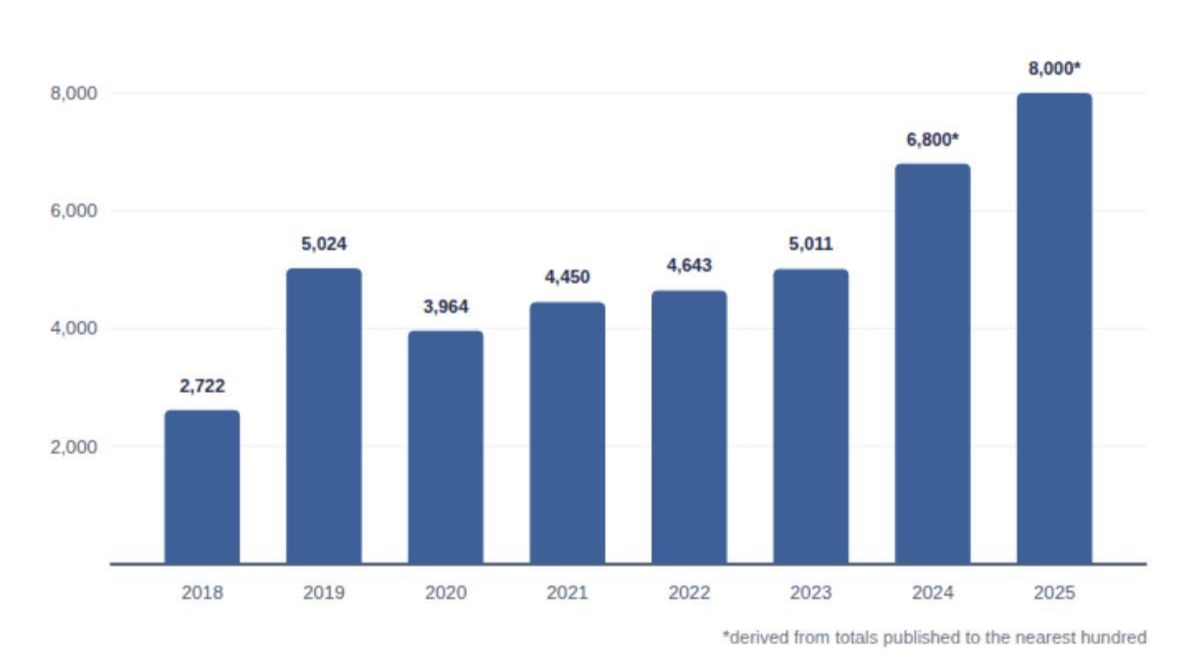
Figure 1: Net Yearly Growth in Members With a Certified 9/11-Related Cancer, 2018 to 2025. Net change by calendar year in the number of living members with at least one certified cancer, based on the Program at a Glance reports for Dec 31, 2017 through Dec 31, 2023 and the External Quarterly Program Summaries for Dec 31, 2024 and Dec 31, 2025. The Program counted 5,622 such members in September 2016 and about 48,900 by the end of 2025. Values marked with an asterisk are calculated from totals that the quarterly reports publish to the nearest hundred. Net growth understates new certifications because members who die or disenroll leave the count; the Program separately reported 10,525 cancer certifications in 2025 alone. Data are preliminary and subject to revision.
The chart shows the latency policy at work across the population. The two largest single-year increases in the Program's history are the two most recent, approximately a quarter-century after exposure. In calendar year 2025, the Program certified 10,525 cancers, representing two of every three conditions it certified that year, and 6,124 of those cancers were diagnosed in the civilian 9/11-exposed population of office workers, residents, students, and downtown workers.
The Most Common 9/11 Cancers Decades After Exposure
By Dec 31, 2025, the Program had recorded 52,927 cancer certifications over its lifetime. For the first time, survivors held more of them than responders: 26,560 compared with 26,367. The most common certified cancers among current members are non-melanoma skin cancer (about 17,000 members), prostate cancer (about 12,100), female breast cancer (about 4,500), melanoma (about 3,600), followed by lymphoma, thyroid cancer, kidney cancer, lung and bronchus cancer, bladder cancer, and leukemia. The Program also certifies rare cancers, including neuroendocrine tumors, pancreatic cancer, and brain cancer.
The age of the 9/11 population is important. Two-thirds of Program members were 22 to 44 years old on Sep 11, 2001. They are now in their 50s, 60s, and 70s, the ages at which cancer risk increases, particularly after toxic exposure. Half of all current members are 65 or older.
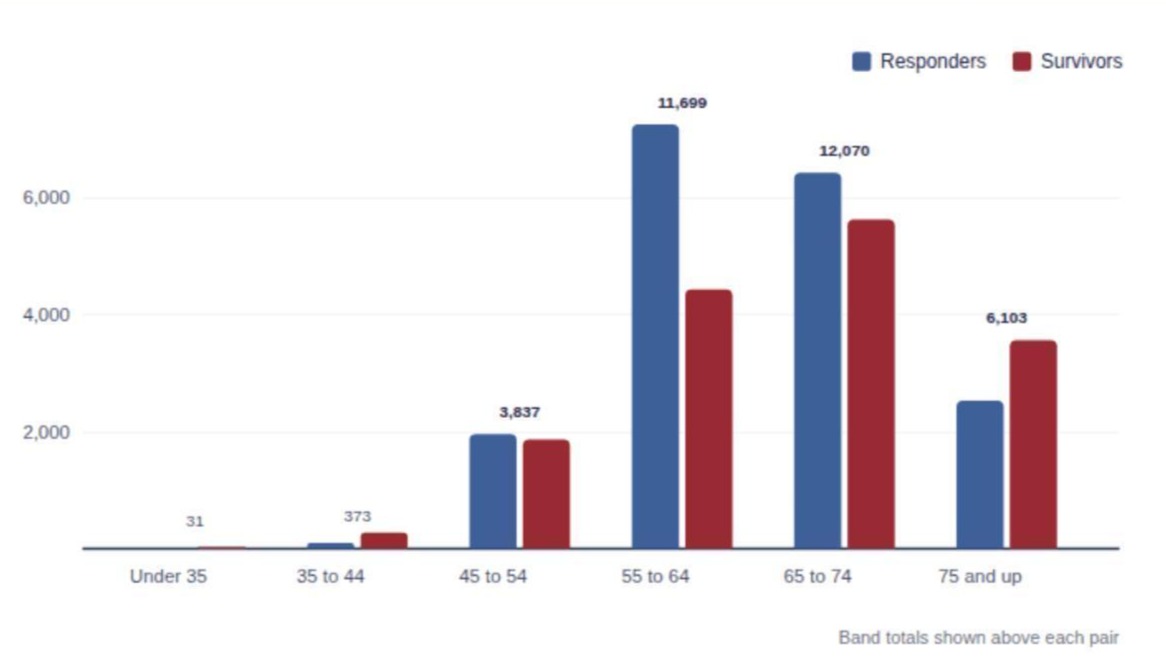
Figure 2: Age of Members Holding a Cancer Certification, Dec 31, 2023. Living members with at least one cancer certification, by current age band and member type, from the Program at a Glance report for Dec 31, 2023, the Program's most recent report to publish this breakdown. Ages are as of the report date, not Sep 11, 2001. The figures exclude 2,781 deceased members who held cancer certifications; members certified in more than one category appear only once. Data are preliminary and subject to revision.
The chart illustrates the pattern of delayed diagnosis. Only a small fraction of members with a cancer certification are under 45, and more than half are 65 or older. People exposed in their 20s and 30s are only now entering the ages at which cancer risk is concentrated. That helps explain why the Program's cancer counts set records a quarter-century after the exposure ended and why a recent diagnosis can qualify for the same health care and compensation benefits as an earlier one. The same aging pattern also helps explain another number: 182 deceased members held cancer certifications in September 2016, and 2,781 did by the end of 2023.
When a member dies of a certified condition, the claim does not die with them. A wrongful death claim belongs to the family, and families are often the last to learn it.
Filing Deadlines for Delayed Cancer Claims
The Health Program has no deadline to enroll. You can apply this year for a cancer diagnosed at any time in the past 20-plus years or after a future diagnosis. The VCF is different. Under its deadlines policy, updated Jul 10, 2026, you generally must register within two years of the date the WTC Health Program, or a similar entity, certifies your 9/11-related condition. For anyone who was not enrolled in the WTC Health Program and did not receive a finding from another entity, such as workers' compensation, that their cancer was 9/11-related, the two-year registration period never began. Those claims may therefore remain timely even when the cancer was diagnosed more than 20 years ago.
Registration is not the same as filing a claim, and it does not obligate you to pursue one. It preserves your right to file, and everyone who registers has until Oct 1, 2090, to file. The order in which you proceed with the WTC Health Program and the VCF matters. The VCF confirms certifications directly with the Health Program, and a claim filed before the condition is certified is treated as premature. Under the VCF's document check procedures, it remains in denied status until the certification and other minimally required documents arrive. For a delayed-cancer claim, the correct sequence is usually WTC Health Program enrollment, WTC Health Program certification, VCF registration, and then VCF filing. Part of an attorney's job is keeping those steps in order and the process moving.
How a 9/11 Attorney Can Help With a Delayed Cancer Diagnosis
Witness statements can fill gaps, but the rules have tightened. Since Feb 1, 2023, the VCF has accepted its own Witness Presence Statement form. Statements generally must come from people who were adults on Sep 11, 2001, and a claim relying only on witnesses requires at least two statements from people who are not related to you. When documents or witnesses truly cannot be found, the VCF's FAQ describes another option: an eligibility hearing at which you testify under oath.
The Health Program's Disaster Area is broader than the VCF's zone and has its own dates, so qualifying for the Health Program does not mean the VCF will approve your claim.
Beyond proving presence, an attorney coordinates the following steps:
- Assessing eligibility under both the WTC Health Program and the VCF, including the different boundaries and date windows that apply to your exposure
- Moving Health Program enrollment and cancer certification forward while leaving medical determinations to the Program's physicians
- Monitoring your registration window and filing only when the claim is complete, so it is not denied as premature or for missing documents
- Amending the claim when a new condition is certified or your losses grow, and presenting testimony and evidence at an appeal hearing after a denial
No attorney can guarantee an award. Careful preparation can reduce the risk and number of avoidable denials and document requests, as well as the months lost between diagnosis and decision.
Schedule a Free Consultation With Hansen & Rosasco
If you were exposed in the aftermath of September 11 and were later diagnosed with cancer, you are within the group these programs were designed to serve, and it is often not too late. You may qualify for no-cost monitoring and treatment through the Health Program and tax-free compensation through the VCF for economic losses, such as lost wages and benefits, as well as noneconomic losses for pain and suffering.
Our attorneys have represented the 9/11 community since 2001. We work on a 10% contingency basis, so there is no fee unless you recover. We also handle the records work required to answer a question that reaches back 25 years. Contact one of our dedicated 9/11 attorneys for a free consultation.