 800-887-7299
New clients often ask the same question: how long do you need to be in lower Manhattan on or after 9/11 to qualify for 9/11 health benefits and compensation? The September 11th Victim Compensation Fund (VCF), the federal program that pays 9/11 victim compensation, does NOT have a minimum duration of time period requirement. The World Trade Center Health Program (WTC Health Program), the corresponding federal program that certifies if a cancer or other condition is 9/11-related and provides healthcare for the related condition, has a list of specific rules regarding duration of exposure to the 9/11 toxins. Most importantly, to be eligible for 9/11 VCF compensation, a claimant must first satisfy the requirements of the WTC Health Program and have their cancer or other condition certified as 9/11-related. So while the VCF does not have its own duration of exposure requirement, the WTC Health Program does, and the duration of exposure rules must be met to later file a claim with the VCF.
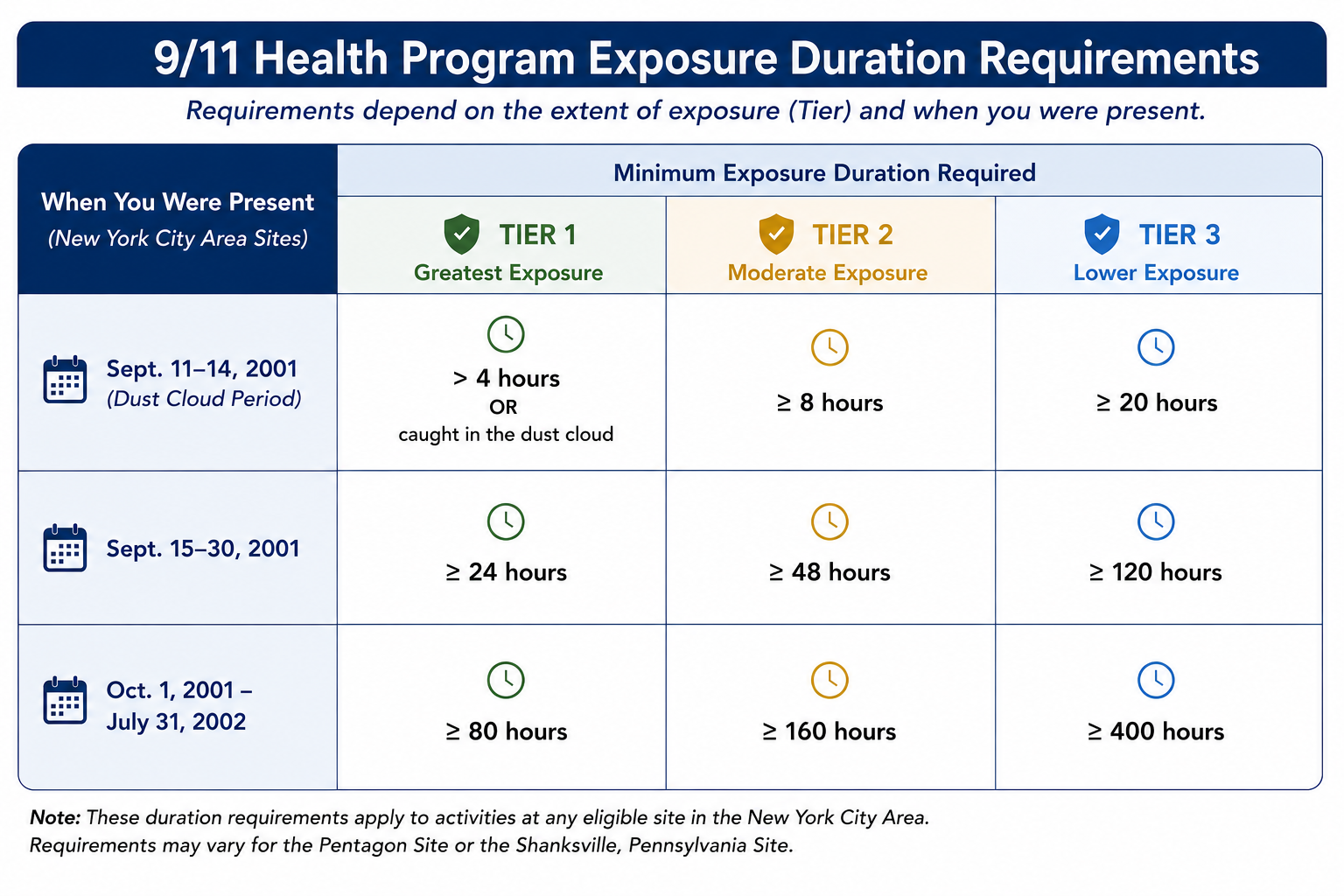
This naturally leads to a second question: What are the duration of exposure requirements? The WTC Health Program rules provide charts that depend on the extent of exposure to the 9/11 dust, how long (the duration) you were exposed, and when (which date(s)) you were exposed. We have summarized these rules in the chart below:
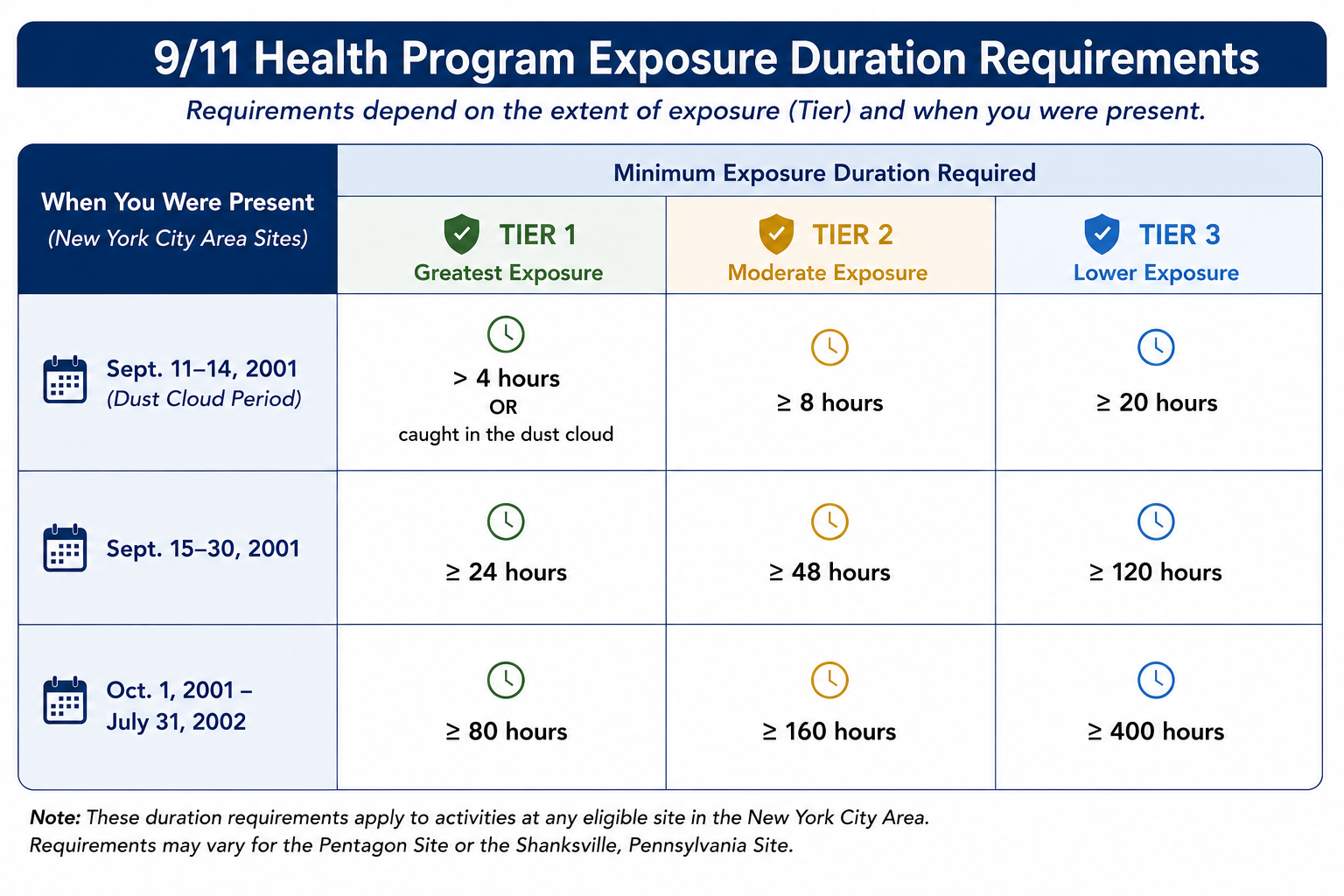
9/11 Exposure Tiers Explained
Tier 1 (Greatest Exposure): People with the highest level of exposure, including those caught in the dust cloud on 9/11, performing rescue, recovery, cleanup, debris removal, construction, or morgue work in heavily contaminated areas, or those who lived, worked, volunteered, or attended school/daycare in areas with heavy dust or smoke exposure.
Tier 2 (Moderate Exposure): People exposed to lighter but still visible dust, debris, smoke, or chemical odors while working, volunteering, cleaning, doing construction, attending school/daycare, or living in contaminated areas.
Tier 3 (Lower Exposure): People in areas without visible dust or heavy smoke exposure, including those who lived, worked, volunteered, attended school/daycare, performed construction or cleaning activities in less contaminated areas, or traveled through the New York City Disaster Area.
What Is Considered “Exposure” Under VCF Guidelines?
To be eligible for compensation under the VCF, individuals must have been present at one of the eligible locations during the following timeframes:
-
The World Trade Center or the surrounding New York City (NYC) Exposure Zone between September 11, 2001, and May 30, 2002;
-
The Pentagon site between September 11, 2001, and November 19, 2001; or
-
The Shanksville, Pennsylvania site between September 11, 2001, and October 3, 2001.
How Long Did You Have to be in the Exposure Zone to Qualify for a 9/11 Claim?
There are no requirements for the minimum amount of time an individual needs to be at an Exposure Zone site for purposes of confirming presence with the 9/11 Victim Compensation Fund. However, since claimants must first register with the Health Program and have their illness certified, the WTC Health Program’s Exposure Duration requirements are applicable. Under the James Zadroga 9/11 Health and Compensation Act, individuals present in the aftermath of 9/11 are grouped into two categories: responders and survivors. Survivors are any individuals present in the aftermath of the attacks who do not qualify as responders.
Health Program requirements are nuanced and based on the location, dates of presence, and which eligible groups individuals belong to.
WTC Survivors
WTC survivors include those present in the NYC Disaster Area:
-
For survivors who were present in the dust or dust cloud, there are no minimum hour requirements.
-
Survivors who lived, worked, or attended school, child care, or adult day care between 9/11/2001 to 1/10/2002 must have been present for 4 days, for a minimum of 4 hours each day.
-
Survivors who lived, worked, or attended school, child care, or adult day care between 9/ 11/2001 to 7/31/2002 must have been present for 30 days, for a minimum of 4 hours each day.
-
Survivors who worked as a cleanup worker or performed maintenance with extensive exposure to WTC dust, but whose activities do not meet general responder criteria, must have been present for a minimum of 4 hours.
WTC General Responders
Responders who were present in Lower Manhattan (south of Houston Street), the Staten Island Landfill, or Certain Barge Loading Piers:
-
Those present between 9/11/2001 to 9/14/2001 must have been present for a minimum of 4 hours.
-
Those present between 9/11/2001 to 9/30/2001 must have been present for a minimum of 24 hours.
-
Those present between 9/11/2001 to 7/31/2002 must have been present for a minimum of 80 hours.
Separate guidelines exist for responders who were active or retired members of the NYC Police Department, Fire Department of the City of New York, Port Authority Police, the Port Authority of New York and New Jersey, employees of the Office of the Chief Medical Examiner or other morgue workers, Port Authority Trans-Hudson Corporation Tunnel workers, and Vehicle Maintenance Workers.
Pentagon and Shanksville Responders
Responders who participated in rescue, recovery, demolition, debris cleanup, or other related services at the Pentagon or at the Shanksville, PA, crash site:
-
Those present at the Pentagon between 9/11/2001 to 11/19/2001 must have been present for a minimum of 4 hours.
-
Those present at the Shanksville site between 9/11/2001 to 10/3/2001 must have been present for a minimum of 4 hours.
Can You Still Qualify If You Were Only There Briefly?
You may still qualify for a VCF award even if your time in the exposure zone was relatively brief, especially if you were present in the dust or dust cloud. The WTC Health Program and VCF recognize that even short-term exposure to toxic dust and debris can lead to serious health conditions. Many individuals who were present for only a limited time, such as office workers, students, or visitors, have successfully filed claims for 9/11-related illnesses.
However, it is important to understand that:
-
Spending more time at Ground Zero or in the exposure zone does not directly link to an increase in your VCF payout
-
Compensation is not calculated based on a “per day” or “per hour” exposure formula
-
The focus remains on your diagnosis, its severity, and its impact on your life
In cases of brief exposure, strong documentation, such as proof of presence and medical evidence, becomes especially important.
What This Means for Specific Types of Responders
Exposure guidelines can vary depending on the type of responder or survivor involved. The VCF and WTCHP recognize that different groups experienced different types and intensities of exposure.
-
First Responders and Recovery Workers: Firefighters, police officers, construction workers, and volunteers involved in rescue and recovery operations often had prolonged and repeated exposure. These individuals may have worked at the site for weeks or months, increasing their cumulative exposure to toxic substances.
-
Cleanup and Debris Removal Workers: Those involved in debris removal, including work at locations like the Fresh Kills landfill, may also have experienced extended exposure, though in different environments. Duration and job duties are important factors in documenting these claims.
While exposure duration varies across these groups, the VCF ultimately evaluates claims based on documented illness and its consequences, not just time spent in the exposure zone.
How Does Exposure Duration Impact My VCF Payout?
While exposure duration is important for determining eligibility to enroll with the World Trade Center Health Program, to then ultimately file a claim with the September 11th Victim Compensation Fund (VCF), the VCF does not base compensation amounts on how long you were exposed. Instead, the VCF evaluates the amount of each claim based on individual circumstances, including the type and severity of the certified illness resulting in a statutory pain & suffering award amount, the effect of the condition(s) on the individual’s ability to maintain normal activities of daily living, and economic losses. However, understanding how exposure duration fits into the larger claims process and what eligibility requirements need to be met can help you better prepare your claim and ensure you receive the full compensation available.
How the September 11th Victim Compensation Fund (VCF) Calculates Compensation
The VCF calculates compensation based primarily on two categories:
-
Economic losses, such as lost wages, reduced earning capacity, and out-of-pocket medical expenses
-
Non-economic losses, including pain and suffering, caused by a physical 9/11-related illness certified by the World Trade Center Health Program
Each claim is reviewed on a case-by-case basis, and the Special Master determines the final award using established guidelines. Compensation from the VCF is linked more closely to the impact of your 9/11-related illness than to the length of time you were exposed. For example:
-
A claimant with a severe, debilitating condition may receive a higher award than someone with a less severe condition, even if the latter had longer exposure
-
Deceased claims may result in different compensation calculations based on wrongful death factors and economic loss to the family
How Exposure Duration Impacts Different Types of Claims
Exposure duration can affect different types of VCF claims in distinct ways.
-
Personal Injury Claims: For personal injury claims, exposure duration helps establish a connection between your condition and 9/11 exposure. However, compensation is primarily based on the type of illness, whether the condition is certified by the Health Program, the severity of symptoms, and economic losses, such as missed work or reduced earning capacity.
-
Deceased Claims: In deceased claims, exposure duration may be used to support the argument that a 9/11-related illness contributed to the individual’s death. This is particularly important when establishing eligibility for a wrongful death award.
-
Multiple Conditions: If a claimant has multiple certified conditions, exposure duration may help explain cumulative risk. However, as with other claims, compensation still depends on the overall impact of those conditions rather than the length of exposure alone.
How to Prove Your Time and Presence at a 9/11 Exposure Site
To successfully file your claim, you must provide documentation showing that you were present in a qualifying location during the required time period.
Common forms of proof include:
-
Employment records or pay stubs
-
School transcripts or attendance records
-
Lease agreements or utility bills
-
Government or employer-issued identification
-
Witness statements
For those with shorter exposure periods, detailed and credible documentation becomes even more critical. The VCF carefully reviews all submitted evidence to verify presence and eligibility.
Speak With the 9/11 Attorneys at Hansen & Rosasco About Your VCF Claim
While exposure duration is an important part of your 9/11 story, it is only one piece of the larger picture. The VCF evaluates each claim based on a combination of factors, including medical evidence, financial impact, and supporting documentation. Because the process can be complex, and because small details can significantly affect your claim, working with an experienced 9/11 attorney can make a significant difference in the award you receive.
The attorneys at Hansen & Rosasco, LLP have over two decades of experience handling VCF claims for individuals with a wide range of exposure durations, from those who spent months at Ground Zero to those who were present only briefly but later developed serious health conditions. We can help you determine your eligibility, gather proof of presence documentation, register with the Health Program, and file a claim with the VCF. Contact the dedicated team at Hansen & Rosasco, LLP today to discuss your VCF claim.