
 800-887-7299
No. A history of smoking does not prevent you from filing a 9/11 lung cancer claim for compensation or seeking health benefits through the World Trade Center Health Program. Lung cancer is among the cancers the Health Program recognizes as a covered WTC-related health condition.
Many people assume they are automatically disqualified from receiving benefits for a 9/11-related lung cancer diagnosis if they smoked at any point in their lives. That is not true. If you were present in a qualifying 9/11 exposure area and your lung cancer has been certified by the World Trade Center Health Program (WTCHP), you may still qualify for medical care and financial compensation. The Health Program and the September 11th Victim Compensation Fund (VCF) recognize that a person may have multiple risk factors for cancer. A smoking history alone does not make someone ineligible.
Early detection of lung cancer generally leads to better health outcomes. Health Program members should discuss symptoms and lung cancer screening with their Program doctor. As explained below, annual low-dose CT screening has specific age and smoking-history requirements.
Smoking Does Not Disqualify You From a 9/11 VCF Claim
Even if you are a heavy smoker or smoked in the past, that fact does not disqualify you from filing a claim with the VCF. Many people diagnosed with lung cancer have a smoking history. Others never smoked. Multiple factors can contribute to lung cancer, and you are not required to prove that the cancer had only one cause.
Eligibility for Health Program benefits and VCF compensation instead turns on other requirements, including:
- You satisfy the applicable Health Program exposure and certification requirements.
- You can establish presence in the applicable VCF zone during the covered period.
- Your lung cancer has been certified by the Health Program.
- You satisfy the VCF filing and documentation requirements.
If those requirements are met, a smoking history does not automatically prevent you from qualifying.
Whether you were a firefighter, office worker, construction worker, volunteer, resident, student, or otherwise present in Lower Manhattan during the applicable covered period, you may still have a valid claim if you were exposed and later developed a certified 9/11-related cancer.
How the VCF Evaluates a Lung Cancer Claim With a Smoking History
The VCF does not require claimants to prove that 9/11 exposure was the only reason they developed lung cancer. Once the Health Program certifies lung cancer as a WTC-related condition, the VCF generally relies on that certification when evaluating the eligible condition. The VCF then applies its separate rules for presence, claim documentation, and compensable economic and noneconomic losses.
Because smoking is a well-known risk factor for lung cancer, many people understandably think the government will deny their claim. In practice, cancer may develop from a combination of environmental exposures, genetics, lifestyle factors, and chance. The fact that someone smoked does not erase the effects of exposure to the toxic dust and debris released after the collapse of the World Trade Center.
The important question is not simply whether you smoked. It is whether you meet the requirements of each program.
Will Smoking History Reduce Your VCF Compensation?
No. A smoking history does not automatically reduce a VCF award. The VCF calculates compensation primarily by considering factors such as:
- The type and severity of the certified condition
- Pain and suffering
- Documented economic losses, such as lost income or reduced earning capacity
- Other factors addressed in the VCF regulations and published policies
The VCF does not publish a rule imposing a fixed reduction simply because someone smoked, had other cancer risk factors, or had other preexisting conditions.
Smoking history may appear in medical records or be discussed during the claims process because it is part of the person’s overall health history. That does not mean compensation will automatically be reduced or denied. Each claim is evaluated individually. Other medical conditions may matter when the VCF considers whether a claimed disability, reduction in earnings, or other loss was caused by the eligible lung cancer, but that is different from an automatic smoking penalty.
What Evidence Strengthens a Lung Cancer Claim for Smokers
Whether you smoked or not, the same core evidence supports a lung cancer claim. The most important documentation generally includes:
- Proof that you were present in the applicable VCF zone during the covered period
- Health Program certification of your lung cancer
- Medical records documenting the diagnosis and treatment
- Pathology reports and imaging studies
- Employment, residency, school, or other records establishing presence
If employment or other historical records no longer exist, proving presence can be difficult. Appropriate witness statements and other supporting evidence may help fill a genuine gap. An experienced 9/11 attorney can evaluate the available records, identify potential problems, and help develop the strongest support available for the individual claim.
Do You Have to Disclose Smoking History on a VCF Claim?
Yes. Medical history should always be disclosed thoroughly and honestly. Medical records often include information about current or former tobacco use, and trying to hide or minimize that history can create unnecessary inconsistencies and questions during the claims process.
In our experience, many people with a smoking history have received Health Program certification and VCF compensation for lung cancer. Providing complete and accurate information helps the programs evaluate the claim on the correct record and can prevent avoidable delays or requests for additional documentation.
Smoking History Matters Differently for Screening
Smoking history plays a direct role in the Program’s annual lung cancer screening benefit. Under the May 2026 lung cancer screening guidance, annual low-dose CT screening is offered to eligible members who are 50 through 80 years old, have at least a 20 pack-year smoking history, and currently smoke or quit completely within the preceding 15 consecutive years.
Those are screening criteria for people at high risk who do not yet have symptoms. They are not the test for whether an already diagnosed lung cancer can be certified. A person may fall outside the annual screening criteria and still require diagnostic evaluation for symptoms or an abnormal finding. Conversely, qualifying for screening does not certify cancer or establish VCF eligibility.
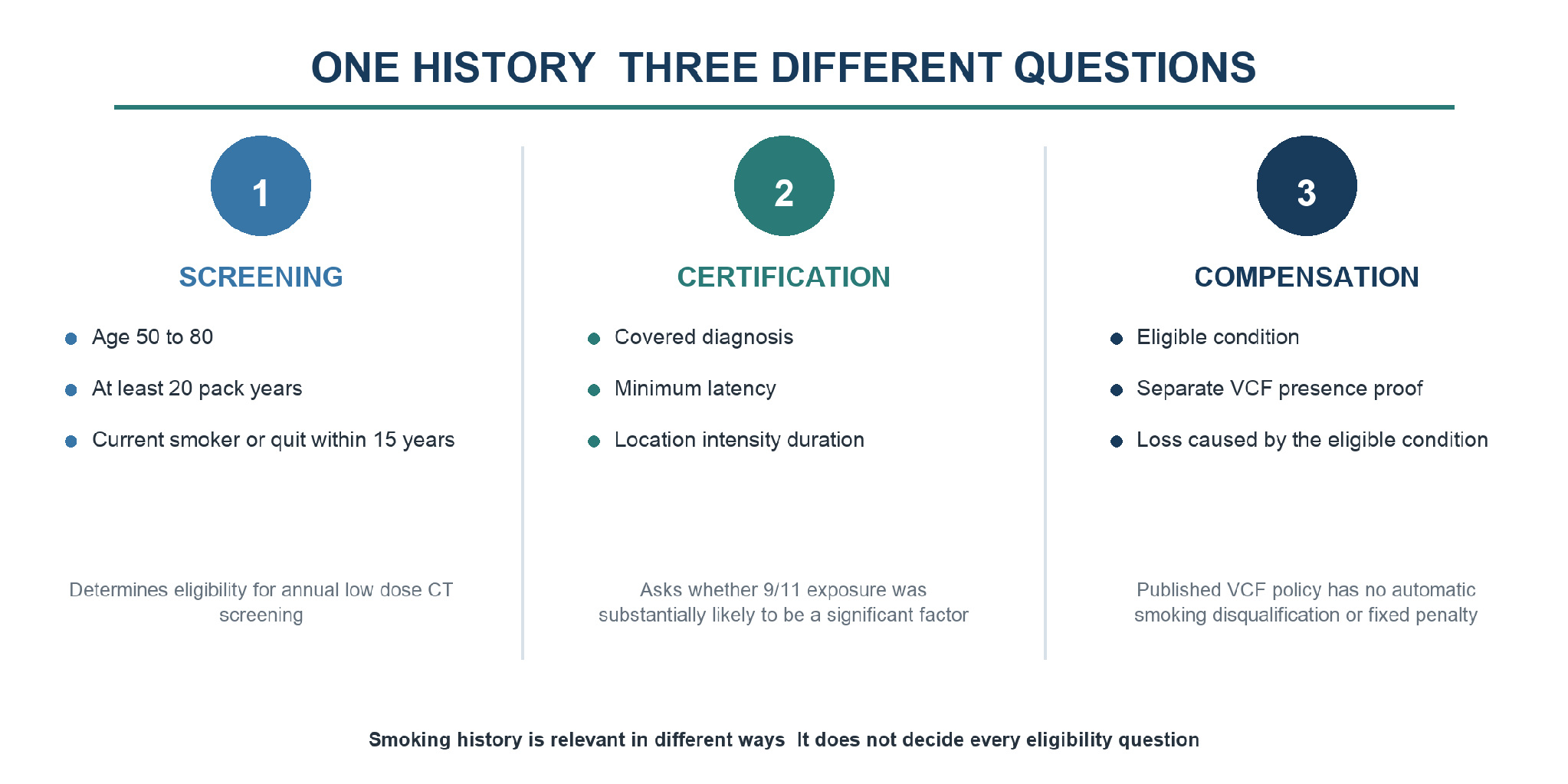
Smoking history is relevant in different ways. Sources: WTC Health Program screening guidance; certification policy; and VCF eligibility and compensation policies.
Low-dose CT screening also has limits and potential harms, including false-positive results and radiation exposure. The Program advises members to discuss the benefits and risks with their doctor. The same guidance provides smoking-cessation services at no cost to members who are eligible for the screening benefit.
Speak With a 9/11 Lung Cancer Lawyer Before You File
If you have been diagnosed with lung cancer after qualifying 9/11 exposure, do not assume a smoking history makes you ineligible for compensation. Preexisting conditions and multiple risk factors do not automatically defeat eligibility.
At Hansen & Rosasco, LLP, we understand the concerns many people have about filing a lung cancer claim. We can help evaluate eligibility, explain how the Health Program and VCF apply to the specific circumstances, gather the documentation needed to support the claim, and guide the client through the process. If you were present in the applicable 9/11 exposure area and have been diagnosed with lung cancer, contact our experienced 9/11 lung cancer lawyers for a free consultation.