
 800-887-7299

If you responded to the World Trade Center, or you lived, worked or went to school in lower Manhattan or the nearby part of Brooklyn in the months after 9/11, you may be able to get cancer screening through the federal World Trade Center (WTC) Health Program at no out-of-pocket cost. More than 25 years have passed since 2001, and most people who were downtown then are now in the age ranges for breast, colorectal and lung cancer screening. This post explains which screenings the Program covers at each age, what your 9/11 exposure does and does not change, and why the screening benefit works differently for responders than for downtown residents, workers and students.
The Program calls residents, workers and students “survivors.” That term does not mean you had to escape one of the towers or be downtown on September 11th itself. Under the Program’s eligibility rules, you may qualify as a survivor if you were caught in the dust cloud on 9/11, or if you lived, worked, or went to school or day care in the NYC Disaster Area for at least four days between September 11, 2001 and January 10, 2002, or at least 30 days between September 11, 2001 and July 31, 2002, with each day lasting at least four hours. The NYC Disaster Area is Manhattan south of Houston Street and any block in Brooklyn wholly or partly within 1.5 miles of the former World Trade Center site. There is no deadline to enroll.
Why Cancer Screening Matters More Now, 25 Years After 9/11
Cancer is now the condition the WTC Health Program certifies most often, and its members have reached the ages when cancer is most often found. In the 12 months ending June 30, 2026, the Program certified 10,393 cancers, 5,762 of them for survivors and 4,631 for responders, according to its quarterly program summary published August 1, 2026. The next most frequently certified condition that year, gastroesophageal reflux disease, had 1,553. The same report shows that 51 percent of currently enrolled members are 65 or older and another 35 percent are between 55 and 64. These figures count certifications and current members only. They do not measure how many people were exposed, and they do not measure anyone’s individual cancer risk.
The ages matter because screening rules are set by age. A student who was 16 at a downtown high school in 2001 is 41 or 42 today, inside the age range for breast cancer screening and a few years from colorectal screening at 45. An office worker who was 35 on 9/11 is now in the age range for all four screenings the Program covers.
Time also matters for certification. The Program will not certify a cancer unless a minimum period has passed between a person’s first 9/11 exposure and the cancer diagnosis. The longest of these periods in the Program’s minimum latency policy, revised March 31, 2025, is 11 years, for mesothelioma. For anyone first exposed in 2001 or 2002, every one of those periods has passed. The other certification requirements still apply.
What the WTC Health Program’s Screening Results Show
Members who qualify for lung cancer screening get it far more often than people in the general population. On September 10, 2026, the CDC reported that 54 percent of Program members who met the U.S. Preventive Services Task Force (USPSTF) criteria had lung cancer screening in 2024. The CDC compared that figure with an actual national lung cancer screening rate of 18 percent in 2022. The same CDC release reported that responders with cancer who were enrolled in the Program had mortality rates 26 to 64 percent lower than other New York residents in the same area, across several cancer types including prostate, lung, kidney and colorectal. That finding covers responders, it shows an association rather than a cause, and it does not predict the outcome for any individual.
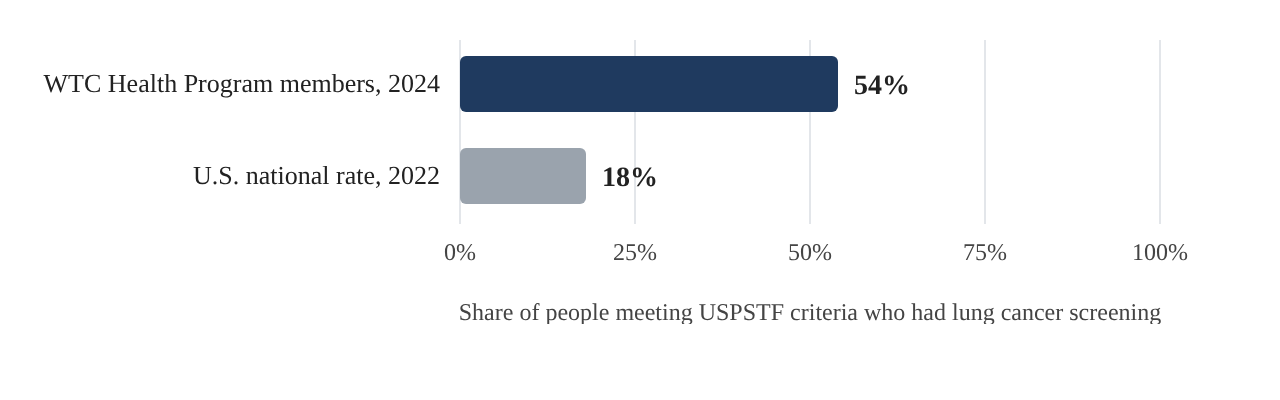
Figure 1. Lung cancer screening among people who met USPSTF criteria. Source: CDC release of September 10, 2026, on a JAMA paper by WTC Health Program staff. The Program figure is for 2024 and covers members who met USPSTF lung screening criteria; the national figure is for 2022. The two figures come from different years and populations. They do not measure breast, cervical or colorectal screening, and they do not measure cancer outcomes.
The reason for screening is stated plainly in the Program’s cancer screening policy: some cancers can be found before they cause symptoms, and cancer treatment is generally more effective when the cancer is found early.
Which Cancer Screenings Does the WTC Health Program Cover?
The Program covers screening for four cancers: breast, cervical, colorectal, and lung. The Program’s Administrative Manual covers only screenings that the USPSTF rates Grade A or Grade B and limits cancer screening to those four cancers. Screening is available to every member except surviving family members of FDNY personnel, who are enrolled for mental health treatment only, as long as the member meets the age and risk criteria for the particular test.
Cancer Screening Guidelines by Age
The age ranges below come from the Administrative Manual and the 2025 Member Handbook. Figure 2 shows them together.
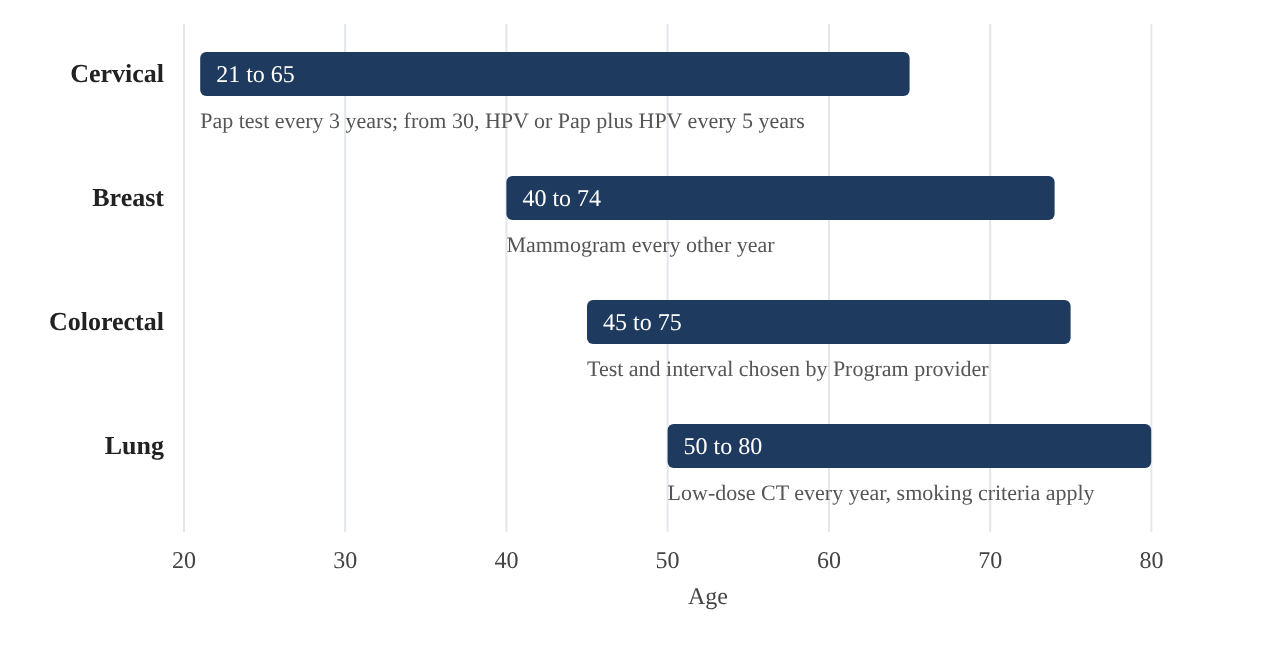
Figure 2. Cancer screenings covered by the WTC Health Program, by age. Source: WTC Health Program Administrative Manual, section 4.13.1, and 2025 Member Handbook, checked November 11, 2026. The chart shows the Program’s coverage rules, not a medical recommendation for any person; each member’s provider applies the risk criteria and exclusions. Lung screening also requires at least 20 pack-years of smoking and smoking within the past 15 years. Survivors without a certified condition are covered only for six months after their initial health evaluation.
Ages 21 to 39: Cervical cancer screening is the only covered screening at these ages. Members ages 21 to 65 may have a Pap test every three years. Starting at age 30, a member may instead choose HPV testing alone or a Pap test combined with HPV testing every five years.
Ages 40 to 49: Mammograms are covered once every other year from age 40 through age 74, and the Program covers an additional mammogram after a positive result. Colorectal cancer screening begins at age 45 for average-risk adults. Average risk means no prior colorectal cancer, adenomatous polyps or inflammatory bowel disease, and no known inherited syndrome such as Lynch syndrome. The Program provider chooses the test and how often to repeat it: a stool test, CT colonography, flexible sigmoidoscopy or colonoscopy.
Ages 50 to 80: Annual low-dose CT lung cancer screening is covered for members with a smoking history of at least 20 pack-years who still smoke or quit within the past 15 years. A pack-year is one pack a day for one year, so 20 pack-years can mean a pack a day for 20 years or two packs a day for 10. According to the Program’s lung cancer screening fact sheet, screening continues each year until age 80 or until the member has been smoke-free for more than 15 years.
Over 65: Each covered screening has an upper age limit. Cervical screening ends after 65, mammograms after 74, colorectal screening after 75 and lung screening after 80. The Administrative Manual also excludes screening when a provider judges that serious other illness makes evaluation inappropriate.
Two rules apply at every age. First, the Program will not repeat a test that was done recently. A mammogram within the past 24 months or a colonoscopy within the past 10 years means you wait until that interval has passed, so bring records of tests you had through your own doctor. Second, screening is for people without symptoms. If you have symptoms that could point to cancer, you need diagnostic testing, not screening, and you should see a doctor without waiting for a screening appointment.
Does Your 9/11 Exposure Level Change Your Screening Schedule?
No. The Program uses the same age and risk criteria for every member, however heavy the member’s exposure was. The Administrative Manual sets the timing and frequency of screening by the USPSTF guidelines and does not add earlier or more frequent screening for heavier 9/11 exposure. Heavy dust exposure alone, for example, does not qualify a member for low-dose CT lung screening without the required smoking history.
Your exposure matters at two other points. It decides whether you can enroll at all, under the activity, location, time period and hours requirements described above. It also matters if a cancer is found. Under the Program’s February 20, 2015 certification policy, the Program’s physicians weigh where you were, how heavy the dust and smoke were, and how many hours you spent there in deciding whether 9/11 exposure was substantially likely to be a significant factor in causing the cancer. That is why the detailed exposure history taken at your first Program exam is worth completing carefully. Tell the clinic about your location, your work, your contact with dust or debris and any symptoms.
Do Responders and Survivors Get the Same Screening Benefits?
No. The screening benefit is different for responders and survivors, and the difference is one of the most important things a downtown resident or worker should know. Responders receive annual monitoring exams and can receive covered cancer screenings whenever they meet the age and risk criteria, with the Program paying directly.
Survivors start out as “screening-eligible survivors.” The Program pays for one initial health evaluation per lifetime, and the Member Handbook says survivors should have symptoms of a WTC-related condition before scheduling it. A screening-eligible survivor can receive covered cancer screenings only from the date of that evaluation until six months afterward. If you are a survivor, plan your mammogram, colorectal screening or lung screening so it falls within those six months.
Survivors who have any WTC-related condition become “certified-eligible survivors.” They receive annual monitoring exams and can receive covered cancer screenings on the regular schedule for as long as they qualify by age and risk. The certified condition does not have to be cancer. Chronic rhinosinusitis, gastroesophageal reflux disease and asthma are among the conditions certified most often, with 42,372, 39,190 and 23,137 certifications held by current members as of June 30, 2026. For a certified-eligible survivor, the Program bills the survivor’s own health insurance first and pays the rest, which the Program says leaves no out-of-pocket cost for Program benefits. Every member must keep primary health insurance.
Cancers the Program Does Not Screen For
The Program does not cover screening for prostate cancer, skin cancer or melanoma, thyroid cancer or blood cancers such as leukemia, because the USPSTF does not give screening for any of them a Grade A or Grade B recommendation. Every type of cancer is on the List of WTC-Related Health Conditions, however, so each of these cancers can be certified if it is diagnosed. Non-melanoma skin cancer and prostate cancer are the two cancers most often certified among current members, at 18,380 and 13,170 members as of June 30, 2026. A CDC paper on cancer care in the Program notes that studies of 9/11-exposed people have suggested elevated risks of prostate cancer, thyroid cancer and melanoma.
For prostate cancer, the USPSTF recommendation issued in 2018, which remains in effect while an update is being developed, is that men ages 55 to 69 make an individual decision about PSA testing with their doctor, and it recommends against routine PSA screening at 70 and older. A changing mole, a lump in the neck, persistent hoarseness or another new symptom is a reason to see a doctor promptly. If your own doctor diagnoses a cancer, a Program physician can review your records, including the pathology report the Program requires for every cancer, and decide whether to request certification.
What Happens If a Screening Finds Something?
An abnormal screening result does not mean you have cancer, and the Program covers the follow-up testing. Under the cancer screening policy, the Program covers the diagnostic workup of a suspicious finding from a covered screening, following National Comprehensive Cancer Network guidelines, and covers follow-up testing of precancerous findings. For screening-eligible survivors, the Administrative Manual ties the cancer diagnostic benefit to the initial health evaluation period, so ask the clinic how long follow-up testing will be covered.
If the testing finds cancer, the Program physician decides whether 9/11 exposure was substantially likely to be a significant factor and, if so, asks the Program to certify the cancer. Having a listed cancer is not the same as having that cancer certified. Certification is an individual decision made by the Program. Once a cancer is certified, medically necessary treatment from Program providers is covered, and treatment decisions belong to the treating physicians.
A certified physical condition may also support a claim with the September 11th Victim Compensation Fund (VCF), which is a separate program run by the Department of Justice with its own rules. To be eligible, you must have been present in the VCF’s NYC Exposure Zone, which for the general public is Manhattan south of the Canal Street line, at some time between September 11, 2001 and May 30, 2002. The Health Program’s NYC Disaster Area is larger, so someone who lived on Spring Street may qualify for the Health Program and still need proof of time spent south of the Canal Street line to qualify for the VCF. The VCF requires registration within two years of the most recent Health Program certification of a physical condition, and the deadline to file a claim is October 1, 2090.
How We Help With Health Program Enrollment and VCF Claims
Hansen & Rosasco, LLP represents 9/11 responders and survivors in WTC Health Program and VCF matters. We help clients assemble the proof of presence the enrollment application requires, follow certification requests through the Program, and register and file VCF claims. Screening schedules and medical decisions remain with the Program’s physicians and your own doctors, and certification decisions remain with the Health Program. No attorney can guarantee enrollment, certification or an award. This post is general information, and each claim turns on its own facts.
If you were downtown after 9/11 and want to know whether you may qualify, contact Hansen & Rosasco, LLP for a free consultation.