
 800-887-7299

After non-melanoma skin cancer, prostate and female breast cancer are the next two most frequently certified cancers in the World Trade Center Health Program. Researchers continue to study exactly how 9/11 exposures contribute to cancer development, but both cancers are recognized by the Program as covered WTC-related health conditions. Men can also develop breast cancer, and breast cancer coverage is not limited to women.
The number of prostate and breast cancer certifications was not as large in the immediate aftermath of 9/11 because many cancers take years to become clinically apparent. That interval is called latency. As time has passed, more responders, survivors, and others who were present in the affected community have been diagnosed with these cancers.
How Common Are Prostate and Breast Cancer in the 9/11 Community?
In the WTC Health Program report dated June 30, 2026,, prostate cancer ranked second among the most frequently certified cancers in currently enrolled members, at approximately 13,170. Female breast cancer ranked third, at approximately 4,830. Non-melanoma skin cancer ranked first. These are counts of members with certified conditions, not new diagnoses during that quarter or measurements of cancer risk. The figures appear in the Program’s quarterly summary.
Prostate and breast cancer can affect people from every group that experienced qualifying exposure, including:
- First responders
- Firefighters and police officers
- Construction and recovery workers
- Office workers
- Residents
- Students and teachers
- Volunteers
- Journalists and photographers
- Others who lived, worked, attended school, or spent time in the applicable New York City exposure area
First responders are not the only people who may qualify. Presence and exposure matter more than a job title, although the Health Program and the 9/11 Victim Compensation Fund (VCF) apply their own geographic, time, and documentation requirements. Both programs recognize several categories of responders and survivors.
Why Prostate Cancer Became So Common After 9/11
The toxic dust and debris released by the collapse of the World Trade Center contained many hazardous substances, including asbestos, benzene, dioxins, polycyclic aromatic hydrocarbons, heavy metals, and other known or suspected carcinogens. Responders and survivors could have been exposed while the dust remained in the air and settled on streets, buildings, workplaces, schools, and homes.
Scientists continue to investigate how those exposures may contribute to prostate cancer. Prostate cancer is now a covered WTC-related health condition, but it was added separately in 2013, after the Program’s 2012 cancer rule. That coverage history recognizes prostate cancer for possible certification while preserving an individual medical review.
Why Breast Cancer Became So Common After 9/11
Researchers have also examined whether environmental exposures contributed to breast cancer in the 9/11 community. In recommending breast cancer coverage, the Health Program’s Scientific/Technical Advisory Committee considered substances that can interfere with hormones, including PCBs, while acknowledging limits and conflicting evidence in the available studies. It also considered the disruption of normal daily rhythms associated with shift work.
Breast cancer was included in the Program’s 2012 cancer rule. It has been certified in office workers, downtown residents, students, recovery workers, volunteers, and responders. The current Program report also lists 118 members with male breast cancer certifications. That count does not prove that male breast cancer occurs at a higher rate in the exposed population, but it confirms that coverage is not limited to women.
What the Research Actually Shows About 9/11 and Cancer Risk
Research into 9/11 exposures and cancer continues. Federal coverage decisions recognize that certain cancers can be WTC-related, but they do not mean that every cancer in every exposed person was caused by 9/11. The medical determination remains individual.
A member does not have to prove that WTC exposure was the only possible cause of the cancer. For Health Program certification, the Program considers the diagnosis, qualifying exposure, latency, and whether the exposure was substantially likely to be a significant factor in aggravating, contributing to, or causing the condition. The VCF then applies its separate presence and compensation requirements.
Why a Diagnosis Years Later Still Matters
The Program’s minimum-latency policy explains that cancers usually take years or decades to become clinically apparent. Latency is the interval from a person’s initial 9/11 exposure to the initial cancer diagnosis. It is not measured from the application date, and it is not the length of time someone worked or lived downtown.
For adult prostate and breast cancers, the applicable solid-cancer minimum is generally four years. That is a minimum used in certification, not a deadline by which cancer must appear or a prediction of when it will develop. A diagnosis twenty or twenty-five years later should not be dismissed simply because the exposure was long ago. Meeting the minimum does not, by itself, establish eligibility.
The people exposed in 2001 have also grown older. By June 2026, just over half of the Health Program’s currently enrolled members were 65 or older. Those are their ages now, not their ages at exposure or diagnosis. The figures describe the overall membership, not a prostate or breast cancer patient group.
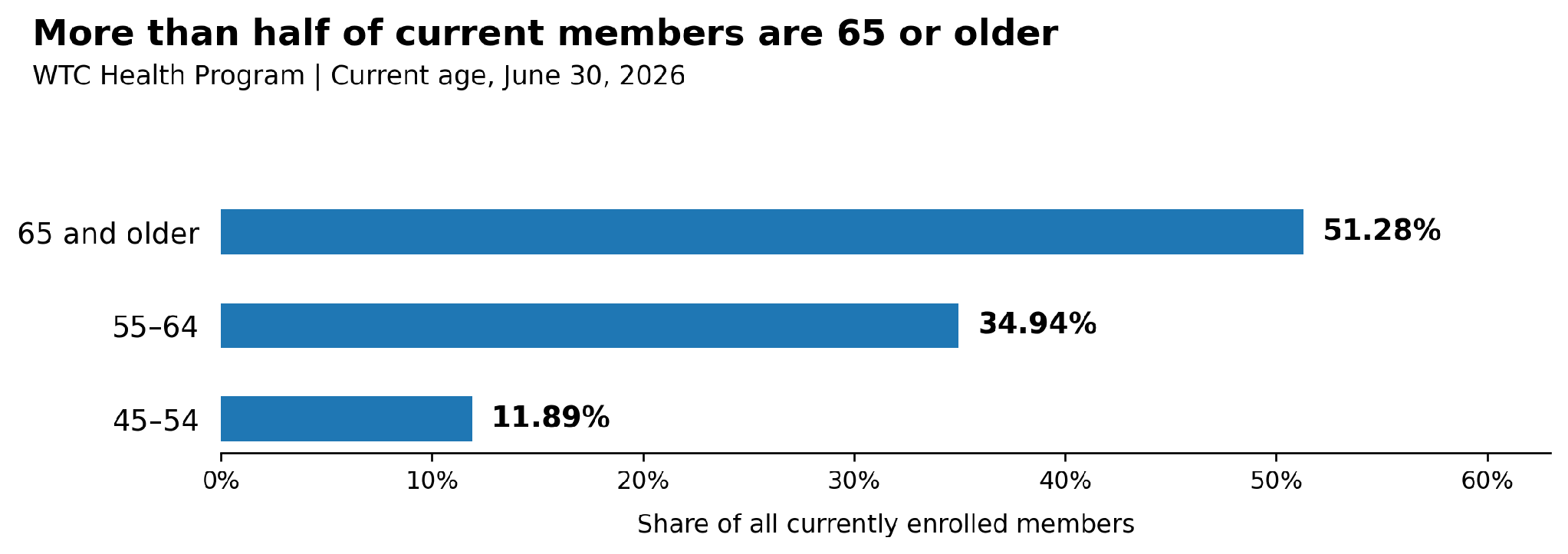
Figure 1. Enrollment applications received in calendar years 2022–2025, combining responder and survivor counts. Not approvals, VCF claims, or a closed-employer subset. Source: WTC Health Program June 30, 2026 quarterly report, Figure 12. Data are preliminary and subject to revision.
Screening, Diagnosis, and Treatment Are Different
Both prostate and breast cancer are covered conditions under the WTC Health Program, but screening, diagnosis, certification, and treatment are different parts of the process.
The Program’s May 2026 breast cancer screening guidance explains that eligible women ages 40 through 74 may receive a digital mammogram once every other year. Screening looks for cancer before symptoms appear. An abnormal result may require additional testing; it does not necessarily mean the patient has cancer. The Program covers indicated follow-up and diagnostic tests after an abnormal covered screening.
Prostate cancer treatment is covered when certified, but routine prostate screening is not part of the Program’s cancer-screening benefit. The Administrative Manual limits that benefit to breast, cervical, colorectal, and lung cancer. Diagnostic evaluation is separate. A physician’s assessment of symptoms or an abnormal finding should not be confused with routine screening of someone without symptoms.
The medical record must establish the actual diagnosis. The Health Program’s Diagnostic Essentials guidance to the VCF identifies tissue biopsy or a pathology report as essential evidence for most malignant cancers, subject to specified exceptions. A possible diagnosis, an abnormal screening, and a confirmed cancer are not interchangeable.
The exact breast diagnosis matters. Ductal carcinoma in situ, or DCIS, can be eligible for certification. Lobular carcinoma in situ, or LCIS, is generally excluded, but the Program makes an exception for the pleomorphic form. The pathology and the other certification requirements still need review; the words “in situ” do not produce the same answer in every case.
For a certified cancer, the Health Program can cover medically necessary treatment through participating providers at no out-of-pocket cost to the member. The treatment plan belongs to the medical team. Coverage can also extend to qualifying conditions caused by the cancer’s treatment or progression, subject to separate review. The end of a course of treatment does not necessarily mean the end of a patient’s medical needs.
The Administrative Manual also distinguishes the initial evaluation available to screening-eligible survivors from ongoing monitoring for responders and certified-eligible survivors. Being enrolled, having a condition certified, and receiving ongoing monitoring are different parts of the process. Keep up with appropriate medical care, and do not delay evaluation of a new or worsening problem while questions about benefits are being resolved.
Health Program certification can provide access to medically necessary treatment for the certified condition. VCF compensation is separate. The VCF evaluates its own presence, eligibility, and loss requirements, including economic and noneconomic losses associated with the eligible condition.
What to Do If You Have Been Diagnosed With 9/11-Related Prostate or Breast Cancer
A recent diagnosis does not mean it is too late to seek benefits. The first questions are whether the person meets the applicable Health Program exposure requirements and whether the cancer can be certified. The VCF separately requires proof of presence and compliance with its filing requirements.
The claim work may include:
- Applying for Health Program enrollment if the person is not already a member
- Obtaining Health Program certification of the cancer
- Gathering medical evidence and proof of qualifying exposure or VCF presence
- Protecting the applicable VCF registration, filing, and appeal deadlines
A family history of cancer or other preexisting conditions does not automatically prevent someone with qualifying 9/11 exposure from receiving certification or filing a VCF claim. People who were not first responders may also qualify, but the supporting evidence must satisfy the requirements of the program reviewing it.
Get a Free Case Review From the 9/11 Attorneys at Hansen & Rosasco
A diagnosis of prostate or breast cancer can be overwhelming, but you do not have to navigate the Health Program and VCF alone. At Hansen & Rosasco, LLP, we help responders, survivors, and others in the 9/11 community address Health Program certification, difficult proof-of-presence issues, and VCF compensation claims.
If you were present in an applicable 9/11 exposure area and have been diagnosed with prostate cancer, breast cancer, or another covered cancer, contact Hansen & Rosasco, LLP for a free consultation. Let us help with the documentation and government process so you can concentrate on your health.