 800-887-7299
How the List of Covered 9/11 Health Conditions Has Expanded, Including Coverage for 69+ Different Cancers
The health conditions covered by the World Trade Center Health Program have grown since its inception to include more 9/11-related health conditions. Most significantly, when the WTCHP was established by the Zadroga Act in 2011 it covered only aerodigestive disorders and some other related illnesses but did not cover any cancers until, after mountains of overwhelming research proving the link between the 9/11 toxins and dozens of cancers, they were added to the list of 9/11-covered conditions in 2012.
This means people who do not realize that something like skin, prostate, breast, or other cancer (even if diagnosed before 2012 or any time since then) was denied coverage or compensation, or simply did not apply in the past, may be eligible for health and compensation benefits.
What Was Originally Covered When the WTC Health Program Began in 2011
When the World Trade Center Health Program opened in 2011 under the James Zadroga 9/11 Health and Compensation Act, conditions that had already been widely reported among the 9/11 community were covered.
The original list of covered conditions included:
- Aerodigestive disorders, such as asthma, chronic cough, sinusitis, and gastroesophageal reflux disease (GERD)
- Mental health conditions, including post-traumatic stress disorder (PTSD), depression, and anxiety
- Musculoskeletal disorders for certain responders
- Sleep apnea when associated with another certified condition
Cancer was not initially included. At the time, the government required more evidence to establish the connection between toxic exposure and many forms of cancer.
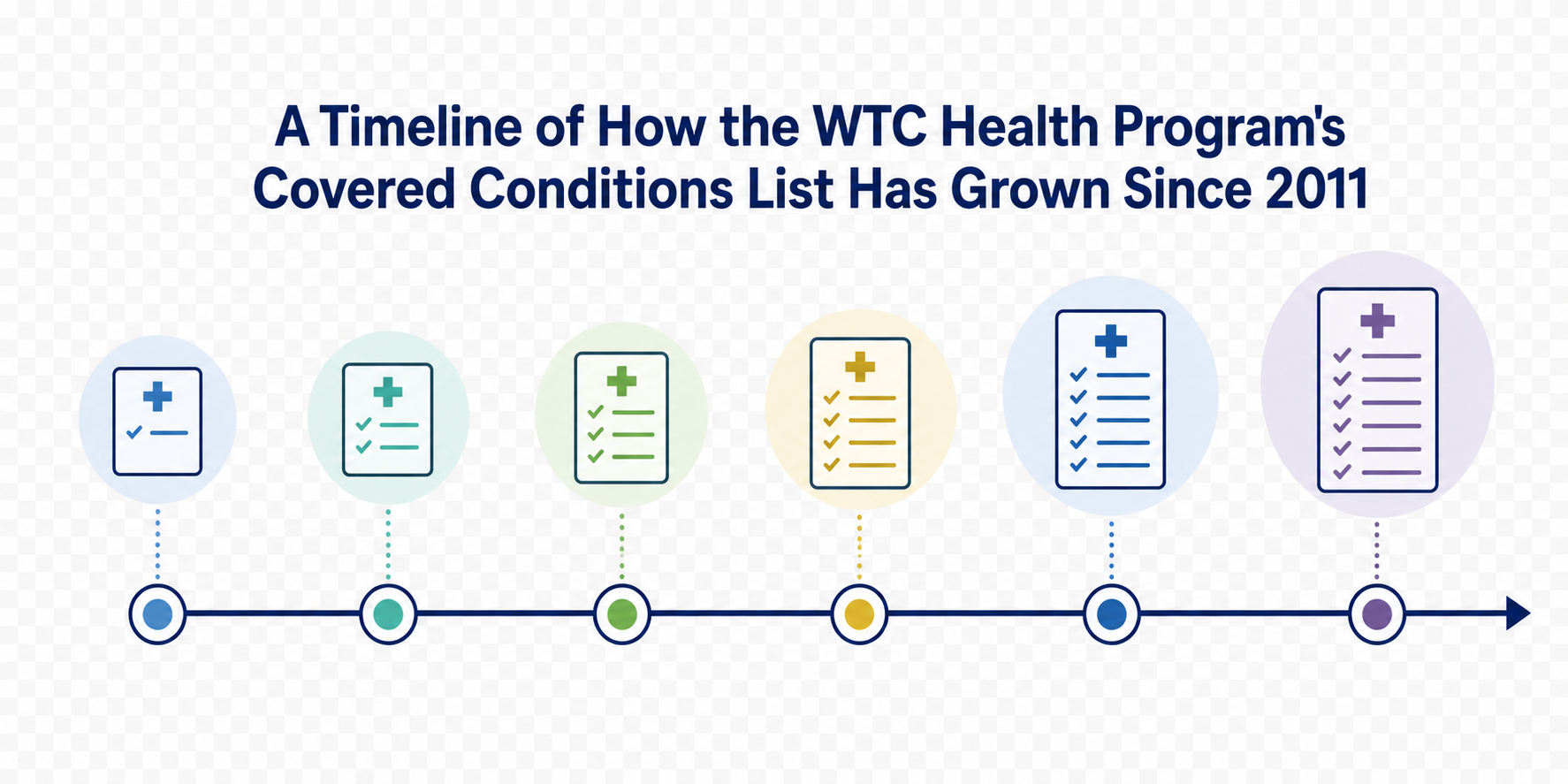
A Timeline of How the WTC Health Program's Covered Conditions List Has Grown Since 2011
The Zadroga Act established a process to consider petitions by interested parties to add new conditions to the list of those covered by the WTC Health Program. Since 2011, several changes have unfolded as a result.
2011: The Program Begins With No Cancer Coverage
When the WTC Health Program began, 9/11 survivors and responders could receive treatment for respiratory illnesses, digestive disorders, and mental health conditions, but cancer was not on the list of covered conditions. Many advocates, physicians, and researchers argued that this would eventually change as more research was done.
2012: Cancer Is Finally Added to the List
In 2012, dozens of cancers were officially added to the list as recommended by the Health Program Scientific/Technical Advisory Committee. The decision made thousands of people who had developed illnesses years after the September 11 attacks eligible for health coverage and compensation. The first cancers added to the list included:
- Lung cancer
- Breast cancer
- Thyroid cancer
- Colorectal cancer
- Leukemia and lymphoma
- Skin cancers
- Kidney and bladder cancer
This was one of the most significant expansions of the list in the program's history.
2013–2014: Prostate, Brain, Cervical, and Pancreatic Cancers Added
As research and advocacy continued, additional cancers were added to the list or clarified, including prostate cancer, brain cancer, cervical cancer, and pancreatic cancer. These additions reflected the research that showed that the effects of 9/11 exposure extended far beyond the illnesses first seen in responders and Lower Manhattan residents.
2015–2016: The Program Is Reauthorized Through 2090
In 2015, Congress permanently reauthorized the World Trade Center Health Program and the September 11th Victim Compensation Fund (VCF), extending coverage through October 1, 2090. This extension acknowledged an important fact: many 9/11-related conditions have long latency periods, meaning they take several years or even decades to develop. People who lived, worked, attended school, or participated in rescue and recovery efforts may not receive a diagnosis until many years after their exposure.
2023: Uterine Cancer Added After a Decade-Long Fight
Uterine cancer was officially added to the list of covered conditions in 2023 after years of advocacy and scientific research. The addition of uterine cancer highlights an important aspect of the list of covered conditions: the list is not fixed. New conditions can be considered and added when evidence supports a connection to 9/11 exposure. For individuals who present in the aftermath of 9/11 whose conditions were previously excluded, these changes can mean a change in eligibility for health coverage and financial compensation.
2024–2025: Coverage Expands for Pentagon and Shanksville Responders
Changes have been made beyond the list of covered conditions. Previously, the World Trade Center Health Program limited Pentagon and Shanksville, Pennsylvania responder eligibility to those in law enforcement, recovery or cleanup contractors, and volunteers. The National Defense Authorization Act (NDAA) of 2024 expanded eligibility for certain active-duty, retired, or reserve members of the military, and civilian employees and contractors of the Department of Defense (DOD) and other Federal agencies who responded to the Pentagon or Shanksville sites.
What Health Conditions Are Covered Today?
Today, the WTC Health Program covers a broad range of physical and mental health conditions, including:
- More than 69+ types of cancer
- Asthma and chronic respiratory disease
- Chronic sinusitis
- Gastroesophageal reflux disease (GERD)
- Chronic obstructive pulmonary disease (COPD)
- Interstitial lung disease
- Sleep apnea associated with another certified condition
- Post-traumatic stress disorder (PTSD)
- Depression
- Anxiety disorders
Eligibility is not limited to first responders – office workers, residents, students, volunteers, cleanup workers, and anyone else who was present in Lower Manhattan during the applicable time frames may qualify.
Preexisting conditions do not disqualify you from receiving benefits. If you were exposed and later developed a covered illness, you may be eligible for health benefits and compensation.
Why the List Keeps Growing and Why That's Good News for You
The list of covered conditions has continued to grow because long-term health consequences of 9/11 exposure are still being understood. Scientists continue to study the effects of inhaling the toxic cloud of dust and debris, which contained asbestos, heavy metals, jet fuel, pulverized concrete, and numerous other harmful substances. As time passes, illnesses that may take decades to emerge are just now revealing themselves.
This may be good news if you have a condition that was not previously certified – just because a condition is not on the covered condition list does not mean that is the final decision.
For example, the World Trade Center Health Program has received petitions asking to add several cardiovascular conditions to the list of covered illnesses, including heart attacks (myocardial infarction), unstable angina, obstructive coronary artery disease, cardiomyopathy, congestive heart failure, and arrhythmias. The Health Program determined that there was not yet sufficient evidence to add ischemic heart disease and related cardiovascular conditions as primary covered conditions.
Don't See Your Condition Listed? It May Still Qualify
Even if your condition isn’t listed as a primary condition, it may still qualify. Some illnesses qualify as medically associated conditions if they result from the treatment or progression of a certified condition. For example, certain secondary illnesses related to cancer treatment or respiratory disease may be covered.
Was Your Condition Added After You Filed or Settled? Here's What That Means
You might think that if you filed years ago, or chose not to file because your illness wasn't covered, that the chance to apply for benefits has passed. However, there are often still pathways to coverage.
If your condition was added after you filed a claim, you may be able to:
- Apply for certification through the WTCHP
- File a new VCF claim
- Amend an existing claim
- Seek additional compensation based on a newly certified condition
Because eligibility rules and deadlines vary depending on the circumstances, it's important to review your options as soon as possible.
Find Out If Your Condition Qualifies by Contacting Hansen & Rosasco Today
The list of covered 9/11 health conditions has changed dramatically since 2011, and it will likely continue to evolve as researchers learn more about the long-term effects of exposure. At Hansen & Rosasco, LLP, we can help you understand whether your conditions qualify for certification and compensation, gather supporting documentation to prove eligibility, and navigate both the WTC Health Program certification process and the VCF claims process.
If you were present after September 11 and have questions about whether your condition is covered, contact our team today for a free consultation.