
 800-887-7299

Many people in the 9/11 community hesitate to file a claim with the September 11th Victim Compensation Fund (VCF) because they worry the money should go to firefighters, police officers, and the families of those who died. It is one of the most common concerns we hear in consultations, and it deserves a direct answer: filing your claim does not take money away from first responder families, or from anyone else. Since July 2019, the VCF has been funded by a law that, in the fund's own words, "appropriates such funds as may be necessary to pay all eligible claims." There is no fixed pot of money, and no one's award shrinks because yours was approved.
The worry did not come from nowhere, because for one stretch of the fund's history it was very nearly true. Our firm has represented 9/11 responders and survivors side by side since 2001, through the years when the fund ran short and through everything Congress did to fix it, and the best way to put the concern to rest is to walk through what the government's own numbers show.
Why People Believe Filing a Claim Hurts First Responders
It is not unusual for survivors to feel guilty about filing. You may have been an office worker, a teacher, a student, or someone who lived in Lower Manhattan, and months of breathing the same air as the men and women who dug at the pile. Many of our clients say some version of the same thing: if there is only so much money, let it go to the families who lost someone.
The feeling is understandable. There was a moment when the fund was running out of money, and it made national news. In February 2019, the Special Master announced that the funding remaining in the VCF would be insufficient to pay all pending and projected claims, and awards were cut by 50 percent for claims filed on or before February 1, 2019 and by 70 percent for claims filed after that date. If that is the last headline you remember about VCF funding, the worry makes sense. It is also no longer how the fund works.
How the VCF Is Actually Funded
When Congress reopened the fund in 2011 under the James Zadroga 9/11 Health and Compensation Act, it appropriated $2.775 billion to pay claims. The Zadroga reauthorization of December 18, 2015 added $4.6 billion, which meant that payments to claimants and the costs of running the fund were together capped at $7.375 billion. It was a fixed amount, though, and claims grew faster than anyone budgeted as 9/11-related cancers emerged. By December 31, 2018, the fund had awarded about $4.8 billion, leaving roughly $2.575 billion for everyone still waiting. The reductions followed in February 2019, and by that June the Special Master was reporting that the fund had awarded $5.174 billion and needed $4.616 billion more than Congress had appropriated to pay the remaining claims in full. Under the law as it then stood, the VCF would stop accepting claims on December 18, 2020.
What happened next is the part every hesitant survivor should know. In July 2019, Congress passed the Never Forget the Heroes: James Zadroga, Ray Pfeifer, and Luis Alvarez Permanent Authorization of the September 11th Victim Compensation Fund Act, by votes of 403 to 12 in the House and 97 to 2 in the Senate. The law extended the claim filing deadline from December 18, 2020 to October 1, 2090, and replaced the capped appropriations with whatever funding is necessary to pay every eligible claim. It also required the Special Master to go back and restore every award that had been reduced, so the people whose compensation was cut by 50 or 70 percent were paid the difference. Congress did none of this blindly. The Congressional Budget Office's cost estimate, published July 11, 2019 while the bill was pending, put the added cost at an estimated $10.18 billion over the first decade alone. Lawmakers read the price and passed it anyway.
That structure is why your claim cannot take money from anyone. Awards are paid based on the eligibility requirements and the facts of each individual claim, not on a first-come, first-served basis. If you are eligible, someone else's claim does not reduce your award, and your claim does not reduce anyone else's.
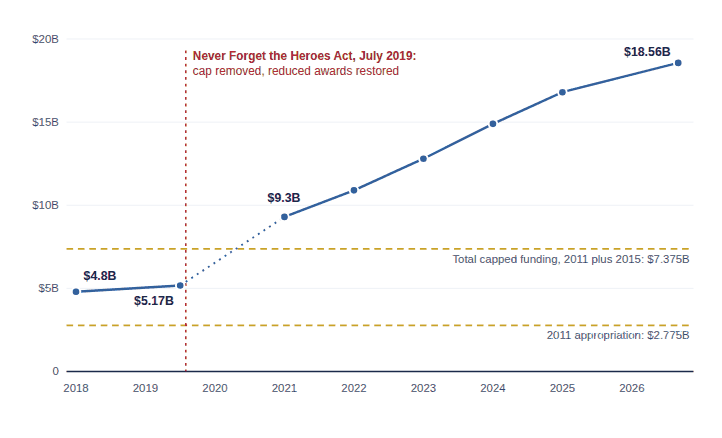
Figure 1. Cumulative compensation awarded by the VCF against its former funding caps, 2018 to 2026. Cumulative award determinations since the fund reopened in October 2011, plotted at the figure each source states: the December 31, 2018 total compiled by the Congressional Research Service, the June 2019 total the Special Master reported to Congress as recorded in the Congressional Budget Office's cost estimate for H.R. 1327, year-end totals from the VCF's 2021 through 2025 annual reports, and the August 31, 2026 monthly statistics report. Amounts are awards determined, not payments completed, and are rounded as published. Year-end 2019 and 2020 totals are not restated in those sources, so the segment between mid-2019 and the end of 2021 is interpolated (dashed). Values through mid-2019 reflect the award reductions then in effect, which were later repaid in full.
The old caps and the money actually awarded no longer fit on the same scale. Through August 31, 2026, the VCF has awarded $18.56 billion, about two and a half times everything Congress appropriated during the capped years, including nearly $2 billion in 2025 and $1.52 billion in the first eight months of 2026. The original fund that ran from 2001 to 2004 awarded $7.049 billion to 5,560 claimants; today's fund has awarded well over twice that. If the old cap still governed, the money would have run out years ago. Instead, awards have continued without reduction for seven years and counting, exactly as the 2019 law directs.
The claims have also outrun every forecast, and the fund has paid them anyway. CBO assumed about 18,100 new claims would be filed and paid in the decade after the law; about 65,000 have been filed since mid-2019, and the fund has awarded roughly $13.4 billion over that stretch, already more than CBO's ten-year projection for the entire bill. When more people file than predicted, the appropriation grows to match. That is the design, and it is the whole answer to the fear that your claim crowds out someone else's.
The VCF Was Never Just for First Responders
Although first responders are the common public face of the 9/11 community, the Zadroga Act has never limited compensation to them. The VCF compensates anyone who was present in the NYC Exposure Zone, the area of Manhattan south of Canal Street at any time between September 11, 2001 and May 30, 2002, and who later developed a certified 9/11-related health condition. That includes office workers and building staff, teachers and students, residents, retail and restaurant workers, utility crews restoring the area, journalists, volunteers, and people whose only exposure was walking to work through the dust in the months that followed. Your occupation does not determine whether you deserve benefits, and health conditions or cancer risk factors you had before September 11th do not automatically disqualify you either.
The government's own filing statistics make the point more plainly than any law firm could.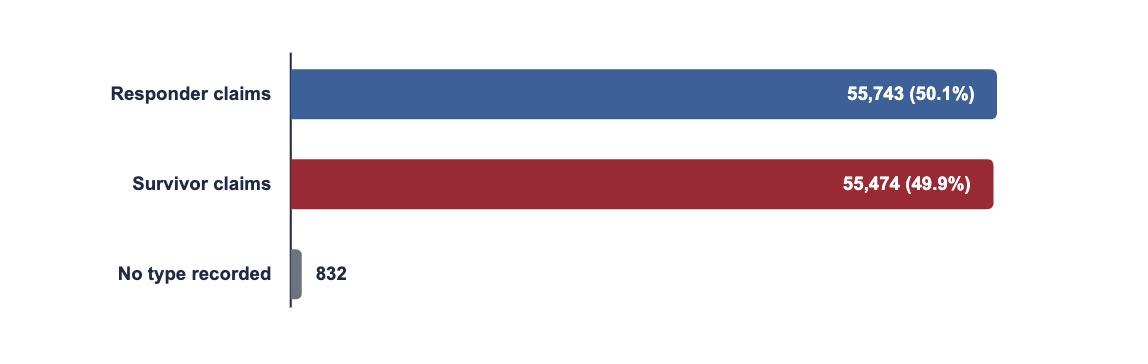 Figure 2. VCF claims filed by claimant type, cumulative through August 31, 2026. Claims filed with the VCF since it reopened in October 2011, as printed in the August 31, 2026 monthly statistics report. Claims are not awards; these counts include claims still in review and claims that were denied. Percentages are of the 111,217 claims with a recorded claimant type. Of all 112,302 claims filed, 102,522 are personal injury claims and 9,780 were filed on behalf of someone who died. Counts are point-in-time figures and change as claims are reviewed.
Survivors have filed 55,474 claims as compared to 55,743 for responders, a difference of a few hundred out of more than 111,000. Families of the deceased are part of both groups: 9,780 claims have been filed on behalf of people who died, and a wrongful death claim filed by an office worker's family draws on the same uncapped funding as one filed by a firefighter's family.
The World Trade Center Health Program calls its non-responder members "survivors," a term that only means you lived, worked, or went to school in the NYC Disaster Area, or were caught in the dust cloud on September 11th. It does not mean you had to escape one of the towers, and the Disaster Area is drawn larger than the VCF's Exposure Zone, so it is worth checking both. Survivors were 13 percent of the Health Program's members in September 2016 and are 39 percent of members enrolled today, and in the twelve months ending June 30, 2026 they accounted for 5,762 of the Program's 10,393 cancer certifications, more than responders did. Congress could see exactly who was filing when it wrote the 2019 law, and it chose unlimited funding anyway. The people the fund was built for include you.
How Individual Awards Are Actually Calculated
VCF awards are not divided among claimants the way a class settlement or an insurance pool would be. Each claim is valued on its own facts. The Special Master looks at which certified condition you have, whether the claim is for personal injury or wrongful death, your economic losses such as lost income and benefits, your non-economic losses for pain and suffering, and any offsets the law requires for payments you received from other sources. Your award is based on your losses. It is not based on how much money remains, because by statute the answer is now however much is necessary, and it is not based on how many other people filed.
What About the World Trade Center Health Program Funding Concerns?
Some of the funding headlines people remember are real, but they are about the Health Program, which pays for medical monitoring and treatment, not compensation. Its enrollment has nearly doubled in a decade, from about 75,700 members in September 2016 to more than 145,000 currently enrolled as of June 30, 2026, and its budget has needed several fixes as membership and medical costs grew. Congress added $1 billion in late 2022 and $444 million in 2023, and after advocates warned of a shortfall of up to $3 billion over the coming decade, with service cuts possible starting in 2027, a provision signed into law in January 2026 funded the Program through 2040 and averted the cuts.
Two things follow. First, Health Program money and VCF money are separate funding under separate laws, so nothing about the Health Program's budget reduces anyone's VCF award. Second, using your Health Program benefits does not take a scarce seat from a responder; the January 2026 fix exists precisely so that everyone who qualifies can be treated. Certification through the Health Program is also how a condition becomes compensable at the VCF, and the VCF confirms certifications directly with the Program, so monitoring protects both your health and your family's claim. Delaying care out of concern for someone else helps no one, and early diagnosis leads to better outcomes.
Does Filing Your Claim Delay Anyone Else's Payment?
No. Your claim enters the VCF's review process on its own track, and it does not move another person's claim backward in line. The most common cause of delay is internal to a claim, chiefly missing documentation. The VCF's own guidance on what happens after you file, updated August 17, 2026, is blunt about it: if minimally required documents are missing, the fund stops processing that claim until the claimant submits them. An incomplete claim slows you down; it does not slow your neighbor. New claims rose from about 700 per month in 2024 to about 900 per month in 2025, and the fund kept pace, with approved eligibility decisions climbing from 58,753 at the end of 2023 to 78,731 by August 31, 2026. Working with an experienced 9/11 attorney helps ensure your claim is complete from the start, which is the one delay you can actually control.
The Real Risk Isn't Filing, It's Not Filing
If you are eligible for the VCF or the WTC Health Program, filing is not taking anything from another family. You are using benefits Congress created, and then twice reinforced, for people in your situation. The deadlines that matter are personal ones. Registering, which is not the same as filing, is what preserves your family's rights, and under the VCF's current deadlines policy, updated July 10, 2026, you generally must register within two years of the date the Health Program certifies a 9/11-related condition. Anyone who registered on or before July 29, 2021 is considered timely, a new certification opens a new two-year window, and once registered, every claimant has until October 1, 2090 to file.
The illnesses themselves are on no one's schedule. Many 9/11-related cancers surface years or decades after exposure, and the Health Program certified 10,393 cancers in the twelve months ending June 30, 2026 alone. Twenty-five years out, this is still an unfolding story. Ongoing screening through the Health Program can catch a condition early, when treatment works best and eligibility is easiest to document.
Speak With an Experienced 9/11 Attorney at Hansen & Rosasco
Whether you were a firefighter at the pile or an office worker at a desk on Broadway, the same fund exists for you, with the same rules and the same money behind it. Our firm has represented responders and survivors together for twenty-five years, and no client of ours has ever ended up with a smaller award because someone else filed.
If you have questions about your eligibility, or you want the registration, certification, and documentation handled carefully the first time, contact one of our dedicated 9/11 attorneys for a free consultation. Filing your claim will not take a dollar from a first responder's family. Waiting could cost yours.