
 800-887-7299

Head and neck cancers are among the conditions recognized by the World Trade Center Health Program. This is not just an issue for firefighters, police officers, and recovery workers. Eligible downtown office workers, residents, students, teachers, and others who lived or worked in the affected area may also qualify for medical benefits and financial compensation. The Program refers to these eligible community members as 'survivors.' That term does not mean you had to escape one of the towers or be there on September 11th itself.
The cancer may already be recognized for coverage. Obtaining approval for an individual patient still requires careful medical review and proof of qualifying exposure. At Hansen & Rosasco, LLP, we help with that work so our clients can concentrate on their health.
Understanding Head and Neck Cancer
Head and neck cancer is a group of cancers, not a single diagnosis. These cancers can begin in the mouth, tongue, tonsils, throat, voice box, nasal cavity, sinuses, or salivary glands. The exact diagnosis matters for both treatment and the review of a 9/11 claim.
Other risk factors can be part of a person's medical history. That does not, by itself, answer whether the cancer qualifies as 9/11-related. Under the Health Program's standard, 9/11 exposure does not have to be the only cause.
The Link Between 9/11 Exposure and Head and Neck Cancer
In 2012, Dr. John Howard, then Director of the National Institute for Occupational Safety and Health and Administrator of the WTC Health Program, reviewed the evidence and determined that dozens of cancers should be added to the Program's covered conditions. The final rule published on September 12, 2012, effective October 12, 2012, specifically included cancers of the mouth, tongue, tonsils, pharynx, nasal cavity, sinuses, salivary glands, and larynx.
The review considered the scientific evidence concerning 9/11 exposures and cancer-causing substances. It established a basis for coverage that an applicant does not have to prove all over again. But the rule also retained an individual medical determination and Program certification. Having a listed cancer is not the same as having that cancer certified.
Why a Diagnosis Years Later Still Matters
The Health Program's minimum-latency policy recognizes that 9/11-related cancers may take many years or decades to appear. Latency is the interval between initial exposure and diagnosis. It is different from how long someone was exposed in 2001 or 2002. A recent diagnosis should not be dismissed simply because so much time has passed.
The Program's published reports also provide a useful historical picture. Members certified for oropharyngeal cancer, which affects the middle of the throat, increased from 243 in June 2019 to 439 in September 2022. The latter included 204 survivors. These are historical counts for one cancer site, not a current total for all head and neck cancers.
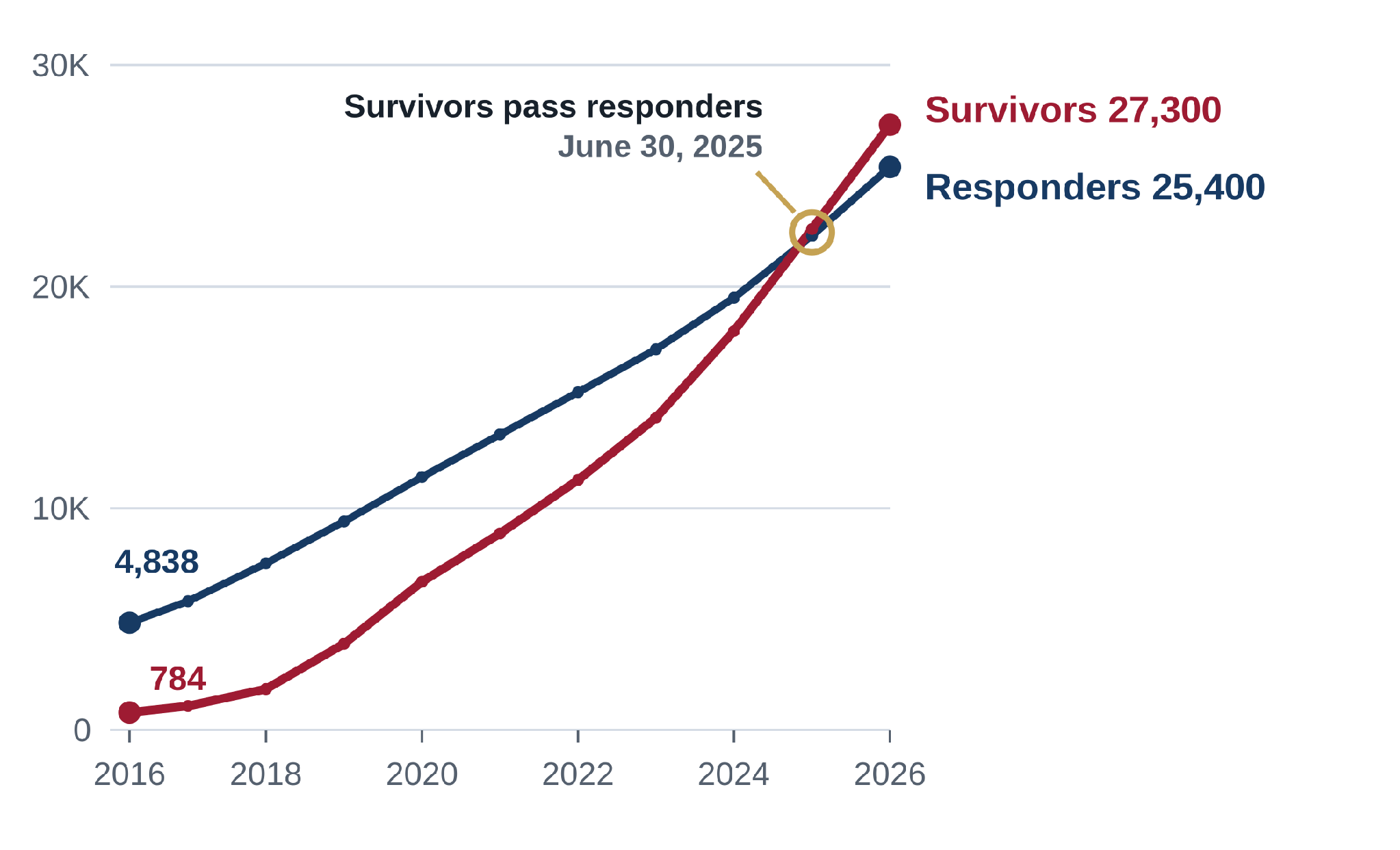
Figure 1. Members with at least one certified cancer, not cancer-incidence rates or head-and-neck-specific totals. Sources: WTC Health Program historical reports and June 2026 quarterly report, Figure 35. September 2016 and June snapshots for 2017-2026; deceased members excluded. Figures for 2024-2026 are rounded. Data are preliminary and subject to revision.
Symptoms and Early Warning Signs to Take Seriously
The concern with head and neck cancers is that symptoms may resemble more familiar problems. Symptoms worth bringing to a physician's attention include:
- A persistent sore throat, hoarseness, or other change in your voice.
- Difficulty swallowing or a new lump or swelling in the neck.
- A mouth sore that does not heal or persistent ear pain.
- Ongoing nasal congestion, repeated nosebleeds, or unexplained weight loss.
Having one of these symptoms does not mean you have cancer. The point is not to diagnose yourself or assume that every symptom is caused by 9/11. It is to seek an appropriate medical evaluation rather than overlook a problem that persists or worsens. Do not delay that evaluation while questions about benefits or eligibility are being resolved.
Diagnosis and Monitoring Through the WTC Health Program
Depending on the symptoms and examination findings, a physician may recommend a specialist consultation, imaging, an examination using a small scope, or a biopsy. The Health Program's Diagnostic Essentials guidance to the VCF identifies tissue biopsy or a pathology report as essential diagnostic evidence for most cancers, subject to specified exceptions. A reference to a possible cancer is not the same as a confirmed diagnosis.
The Program's Administrative Manual distinguishes cancer diagnostic services from treatment of a certified cancer. It also distinguishes the initial evaluation available to screening-eligible survivors from ongoing monitoring available to responders and certified-eligible survivors. Enrollment, certification, and ongoing monitoring are different parts of the process, and the benefits available depend on the member's status.
The Program's routine cancer-screening benefit currently covers breast, cervical, colorectal, and lung cancers, not head and neck cancers. That does not mean a suspicious symptom cannot be investigated. Diagnostic testing is a separate benefit. A routine monitoring appointment is not a substitute for having a persistent throat, mouth, or neck problem evaluated.
Treatment and the Effects That Can Continue Afterward
Treatment depends on the cancer's location, stage, and the patient's health. It may include surgery, radiation, chemotherapy, targeted therapy, immunotherapy, or a combination of treatments. Those decisions belong to the treating medical team.
For a certified cancer, the Health Program can cover medically necessary treatment at no out-of-pocket cost through Program-affiliated providers. Its coverage also extends to qualifying medically associated conditions that result from the treatment or progression of a certified illness. Those conditions require their own review; they are not automatically covered because the cancer is certified.
For head and neck cancer patients, the effects on oral health and nutrition can be particularly important. The end of a course of cancer treatment does not necessarily mean the end of the patient's medical needs.
Dental Care May Be Part of Covered Cancer Care
The Health Program's Dental Services Medical Coverage Determination, revised January 7, 2026, addresses an important benefit that can be overlooked. It permits limited, medically necessary dental evaluation and treatment before chemotherapy and/or radiation for a certified WTC-related cancer, subject to the policy's requirements. The pre-treatment benefit is available only once.
For members with certified head or neck cancers, the policy also allows additional medically necessary dental care after cancer treatment, including qualifying ongoing preventive care. This post-treatment benefit is limited to certified head or neck cancers and must address needs resulting from the cancer treatment. These oral complications can have lasting effects and interfere with nutrition.
This is not general dental insurance. Coverage depends on medical necessity, the relationship to the certified cancer or its treatment, Program-affiliated care, and the required authorization. The pre-treatment benefit may address existing dental disease. The post-treatment benefit does not cover dental disease that the records show predated the cancer treatment.
Why Approval Still Depends on Proof of Exposure
The Health Program and the September 11th Victim Compensation Fund are separate programs. Their geographic boundaries, exposure periods, and eligibility requirements differ. The Health Program's survivor area includes parts of Manhattan and Brooklyn outside the VCF's NYC Exposure Zone. Certification generally supports a VCF claim for a physical illness, but it does not establish every other requirement for compensation.
Dr. Howard's February 20, 2015 certification policy requires consideration of the location, intensity, and duration of exposure. Establishing that someone was in Lower Manhattan is only part of the review. The evidence must support the qualifying circumstances of that person's exposure, along with the medical requirements for the condition.
A person may meet the VCF's presence requirement and still need to satisfy the Health Program's separate certification standards. Our legal work supports that process by addressing the documentation and administrative issues. The medical determination remains with the Program's physicians, and certification remains with the Health Program.
Affidavits, Witness Statements, and Missing Records
Twenty-five years later, proof of presence can be difficult to obtain. Employers may have closed or merged. Old records may no longer exist. Former coworkers may be difficult to locate. A person who attended school downtown as a child may have little documentation of their own.
When records are incomplete, witness evidence can be essential. Affidavits, attestations, and permitted witness statements are not interchangeable. The Health Program has its own supporting-documentation rules, and the VCF requires its prescribed witness statement rather than a newly prepared general affidavit. Both the form and the substance matter. A signature alone does not cure missing facts or unexplained inconsistencies.
In the twelve months ending June 30, 2026, the Program reported 2,506 survivor applicants and 1,620 responder applicants whose applications were suspended for insufficient documentation. That is 4,126 applicants affected by the same basic problem: the evidence submitted was not sufficient to complete the review. A suspension is not a denial, but it can delay access to benefits.
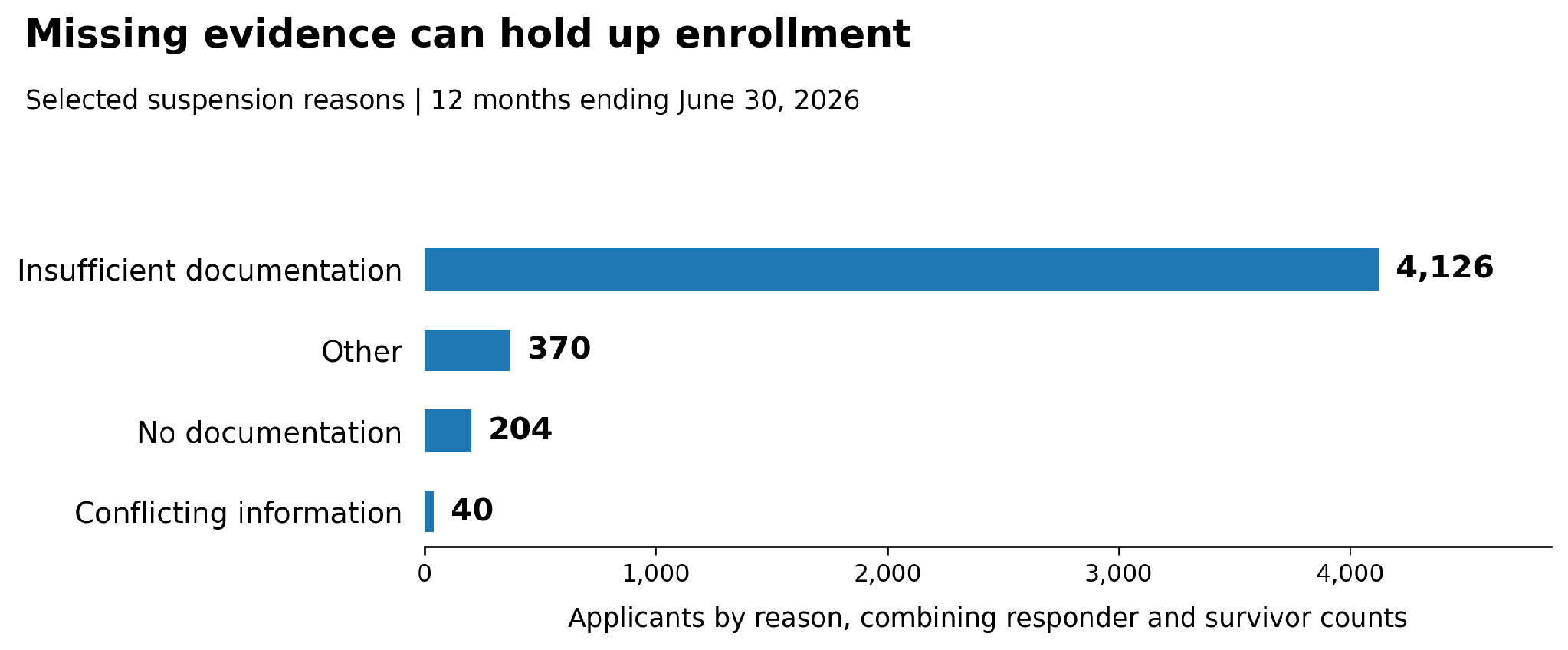
Figure 2. Selected enrollment suspension reasons, combining responder and survivor counts; not denials or a complete total of suspended applications. Source: WTC Health Program quarterly report, Figures 16-17. All enrollment applicants, not a head-and-neck-cancer subset. Data through June 30, 2026; preliminary and subject to revision.
Our attorneys and staff help clients identify available evidence, address gaps, and obtain appropriate witness documentation. We work to present the client's actual history accurately and fully, not leave those issues for the government to discover after filing.
What Compensation May Be Available Through the VCF?
The Health Program provides medical care. The VCF provides financial compensation to eligible claimants for losses associated with qualifying physical conditions. Under the VCF's compensation policies, an award may include pain and suffering, eligible lost earnings and benefits, and qualifying unreimbursed medical expenses. Eligible families may also pursue compensation following a death from a 9/11-related illness.
For head and neck cancer patients, the claim should reflect the actual effects of the illness and treatment, including lasting functional problems and documented financial losses. A diagnosis alone does not tell the whole story. Our work includes helping present that fuller picture so the claim accounts for the compensation supported by the evidence.
The VCF also has separate registration and filing requirements. Health Program enrollment or cancer certification does not automatically register someone with the VCF. A recent diagnosis, an older certification, and a deceased claim can raise different timing issues. Those questions deserve attention while the medical and presence evidence is being developed.
Protect Your Health and Get Help With the Benefits
Keep up with appropriate medical care and report symptoms that persist or change. Do not assume that a new diagnosis cannot be connected to an exposure from years ago. And do not assume that missing records mean there is no way to establish a claim.
At Hansen & Rosasco, LLP, we maintain a dedicated paralegal team focused on WTC Health Program certification. Our attorneys and staff help clients with enrollment, the evidence supporting certification, and their separate VCF claims. When treatment creates additional medical or dental needs, we help clients understand the relevant coverage issues and work with the appropriate Program contacts.
Our goal is to keep a valid claim from being delayed, suspended, or denied because of a missing record, an inadequate witness statement, or an unexplained inconsistency that could have been addressed before filing. No attorney can guarantee approval, but careful preparation and follow-through matter.
If you or someone in your family has been diagnosed with head and neck cancer after being in an area affected by 9/11 or its aftermath, contact Hansen & Rosasco for a free consultation. Let us help with the documentation and government process so you can concentrate on your health.