
 800-887-7299

Being told that your employer is on the VCF’s “Definitive Proof List” can be reassuring. It may mean that reliable records are available to establish where you were after September 11, 2001. That can simplify an important part of your claim. It does not mean that your claim is approved, that you qualify for Health Program benefits, or that the full value of your compensation claim has been established.
At Hansen & Rosasco, LLP, we look at the whole claim. Proving presence, meeting the World Trade Center Health Program’s separate requirements, and documenting the losses caused by an eligible illness involve different evidence and different decisions. An easier presence determination does not take the place of strong advocacy for the maximum compensation the facts and the law support.
What Is the VCF’s Definitive Proof of Presence List?
In January 2023, the VCF published a two-page chart titled Definitive “Proof of Presence” Documents. It identified records and verification arrangements for particular employers, unions, schools, and other circumstances. Its purpose was to identify dependable sources of presence evidence.
The VCF now provides an employer-and-entity table in its presence policies and an Interactive Presence Guide. These resources identify recognized sources of evidence. They are not a list of people who have already been found eligible, and an organization’s appearance does not establish that every employee or member was personally present at a qualifying location.
Why These Arrangements Matter
Reliable institutional records can reduce the need to reconstruct events from memory. In some circumstances, the VCF obtains information directly from the organization. In others, a particular verified record is required. The January 2023 chart also cautioned that it did not cover every situation.
These arrangements extend beyond first responders. The chart includes uniformed services, utilities, unions, financial institutions, school and college attendance, and public-housing records. The evidence still has to fit the person’s actual history. Our role is to identify the applicable requirements and evaluate what the records establish, rather than assume that a familiar employer’s name resolves the issue.
What Does Being on the List Actually Mean for Your Claim?
It may make proving presence more straightforward. It does not guarantee a faster decision or a particular award. The VCF expressly warns that submitting the documents recommended by its Presence Guide does not guarantee eligibility.
Presence is one requirement within a larger review. The VCF must also address an eligible physical condition, registration timeliness, and other applicable requirements. Its preliminary review can stop a claim when required information is missing or insufficient, even when the presence evidence is strong.
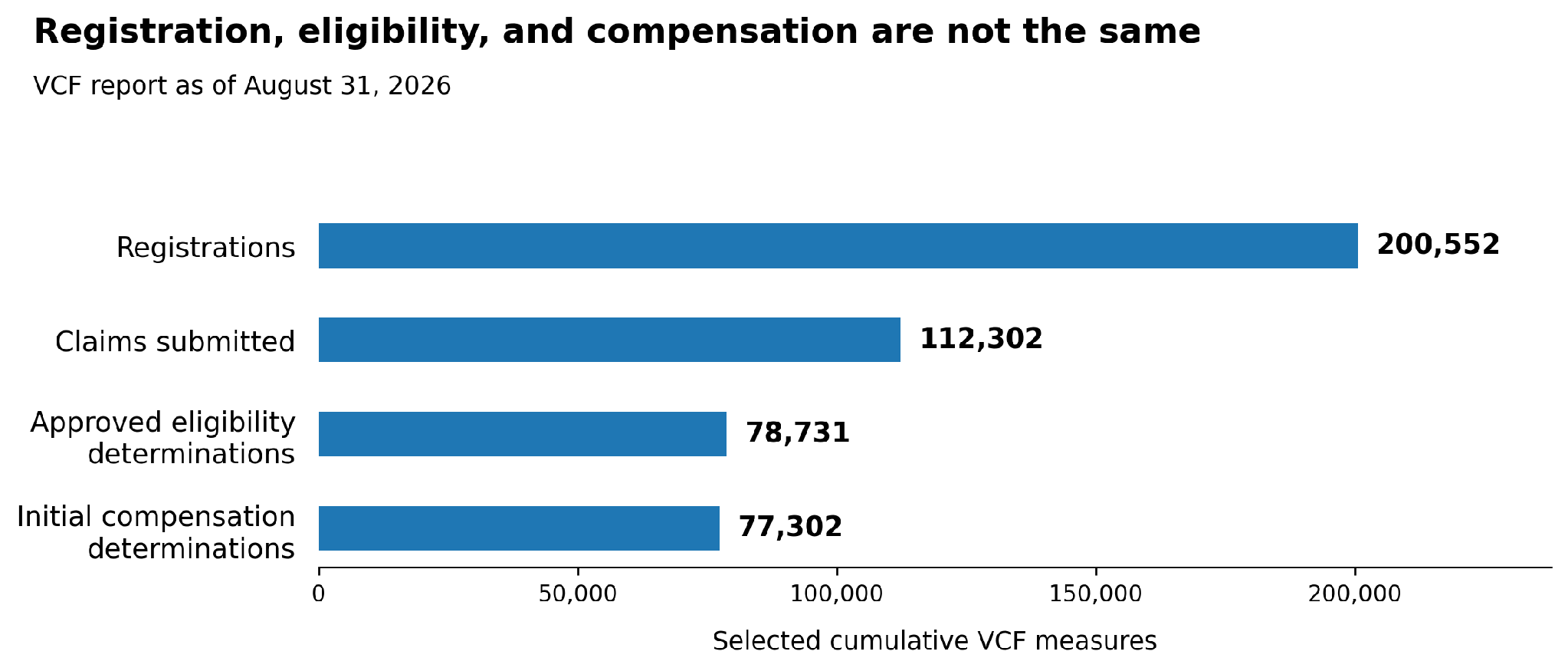
Figure 1. Selected cumulative measures from the VCF August 2026 Monthly Statistics Report, pages 1, 2, and 5. These are overlapping measures, not one group tracked through successive stages. Differences between the bars are not denial rates, a pending-claims count, or evidence that awards were adequate. Amended determinations are omitted. Figures may be revised.
What If Your Employer or Circumstances Are Not Listed?
Not appearing on the chart does not make someone ineligible. The VCF considers other reliable evidence. But a record showing employment or an address does not necessarily establish actual physical presence. Twenty-five years later, closed employers, incomplete archives, and missing records can make that distinction difficult to document.
The Health Program’s Proof Rules Are Not the VCF’s
The World Trade Center Health Program provides medical benefits. The VCF provides financial compensation. They work together, but they do not apply one shared set of enrollment, presence, or medical requirements. The VCF’s Just the Facts guidance expressly distinguishes the two programs.
Geography also differs. For New York City survivors, the Health Program’s Disaster Area includes Manhattan south of Houston Street and specified Brooklyn blocks. The VCF Exposure Zone uses a different boundary, generally along Canal Street, with its eastern extension along Clinton Street. The programs also apply different covered dates and qualifying-activity rules.
The VCF does not impose a minimum period solely to establish presence. That does not waive the separate medical exposure requirements. The Health Program’s enrollment categories have their own criteria, including a distinct category for people present in the September 11th dust or dust cloud. Its enrollment requirements must not be confused with its requirements for certifying a particular condition.
Dr. John Howard’s 2012 cancer rule established the basis for adding dozens of cancers to the covered list, but retained individual medical review. His February 20, 2015 certification policy separately addresses exposure location, intensity, and duration. The medical history and diagnosis must also satisfy the applicable timing rules. For cancer, the minimum-latency policy, revised March 31, 2025, concerns the interval between first exposure and initial diagnosis, not the length of time spent downtown.
The programs also treat witness evidence differently. The Health Program has its own attestation provisions; the VCF has its own sworn witness requirements. Acceptance under one program does not automatically satisfy the other. Nor does a Health Program enrollment decision necessarily resolve the separate VCF question in every case. These differences call for individual review, not a single set of papers sent to both agencies without further consideration
Our dedicated Health Program legal team helps develop the documentation supporting enrollment and certification. The medical determinations belong to the physicians and the Program. We help make sure the individual history is accurately and adequately presented.
The Compensation Case Still Has to Be Made
A presence record answers where you were. It does not explain what an illness has taken from you. Even after eligibility is established, the compensation case deserves its own careful preparation.
Under the VCF’s calculation-of-loss policies, the award combines non-economic loss and supported economic loss, less applicable offsets for certain benefits or payments from other sources. Non-economic loss concerns the nature and severity of the eligible condition and its effects on daily life. Economic loss requires a separate showing of qualifying financial loss caused by the eligible condition.
The VCF expressly states that missing economic-loss documentation may result in an award for non-economic loss only. Receiving an award, therefore, does not necessarily mean that every potentially compensable loss has been considered. A straightforward presence file should not distract from that risk.
Our work includes developing the medical evidence of severity, the effect of treatment and lasting complications, and the connection between an eligible illness and lost earnings or benefits. We evaluate other potentially compensable losses and applicable offsets. A record proving employment in 2001 is not a substitute for the evidence needed to establish financial loss years later.
More diagnoses do not automatically mean more compensation. The VCF’s award guidance emphasizes the type, severity, and impact of the conditions, not simply their number. Strong advocacy means presenting the actual losses under the correct rules. It does not mean promising an award beyond the statutory limits or claiming that hiring a lawyer creates an entitlement to a larger payment.
The Work May Continue After an Initial Award
We also review the determination itself: whether the evidence was considered, the losses were properly calculated, and the result reflects the supported claim. A later change in health or additional loss may warrant further review. The VCF’s amendment and appeal rules distinguish new information from a challenge to an existing decision. Choosing the wrong response or missing a deadline can affect a claimant’s rights. An earlier presence approval does not resolve those issues.
Help With the Whole Claim, Not Just Proof of Presence
At Hansen & Rosasco, we help clients with difficult historical evidence, the Health Program’s separate requirements, and the advocacy needed to seek the maximum supported VCF award. These matters often need attention together. A registration deadline should not be overlooked while records or a medical determination are still being obtained.
Whether your presence is readily verified or requires substantial investigation, it is only one part of the work. Contact Hansen & Rosasco for a free consultation about your complete claim. Let us help with the proof, the government process, and the compensation case so you can concentrate on your health.