
 800-887-7299

If you were a child, a teenager or a college student in lower Manhattan or Brooklyn Heights after 9/11, because your family lived there or because you went to a public, parochial or private school, a day care center or a college there, this post is for you. The World Trade Center (WTC) Health Program is building a Youth Research Cohort to study people who were 21 or younger when they were exposed. Enrollment in that research group has not opened yet. You do not have to wait for it. If you lived or went to school in the area the Health Program covers, you may already qualify for its medical monitoring and treatment, and if you were in Manhattan south of the Canal Street line between September 11, 2001 and May 30, 2002, you may also qualify for the September 11th Victim Compensation Fund (VCF).
What Is the Youth Research Cohort and Who Can Join It?
The Youth Research Cohort is a group of people who agree to take part in future studies of how 9/11 affected the health and education of those exposed when they were young. Congress ordered the Health Program to create it in the Consolidated Appropriations Act, 2023, signed in December 2022, and required that it be large enough to support research. The Program’s Youth Research Cohort page says two groups will be able to join once enrollment opens. The first is people who were 21 or younger on September 11, 2001 and were in Manhattan south of 14th Street or anywhere in Brooklyn at some time between September 11, 2001 and July 31, 2002. The second is people born between September 11, 2001 and April 25, 2003 whose biological mother was in that same area during that period while pregnant with them.
The cohort area is larger than the area that qualifies a person for Health Program benefits. A student at a school on East 10th Street, or a child who lived in Park Slope, may be able to join the research cohort without qualifying for Health Program care on that basis. The Program says in its December 2025 progress update that taking part in the cohort is separate from Health Program membership, does not determine eligibility for benefits, and that declining to take part will not affect the care existing members receive.
Why Former Students and Young Residents Need Their Own Study
Few people who were young on 9/11 are enrolled in the Health Program, although the Program’s own science advisers said years ago that their exposures needed study. In 2012 the Program’s Scientific/Technical Advisory Committee told the Administrator that children who went to school and lived near the World Trade Center site had exposures “in the range of responder populations.” The committee also explained why children are more exposed than adults in the same rooms: they crawl on floors, put their hands in their mouths and breathe faster. At a 2019 committee meeting, the chair of the Program’s Survivors Steering Committee estimated that more than 35,000 children lived in or attended school or day care in the NYC Disaster Area, including more than 19,000 public school students in Disaster Area schools during the 2001 to 2002 school year.
Against those estimates, the Program’s quarterly program summary for June 30, 2026 counts about 2,500 enrolled survivors and about 1,200 enrolled responders who were 21 or younger on 9/11. Figure 1 shows how small that group is next to members who were older on 9/11.
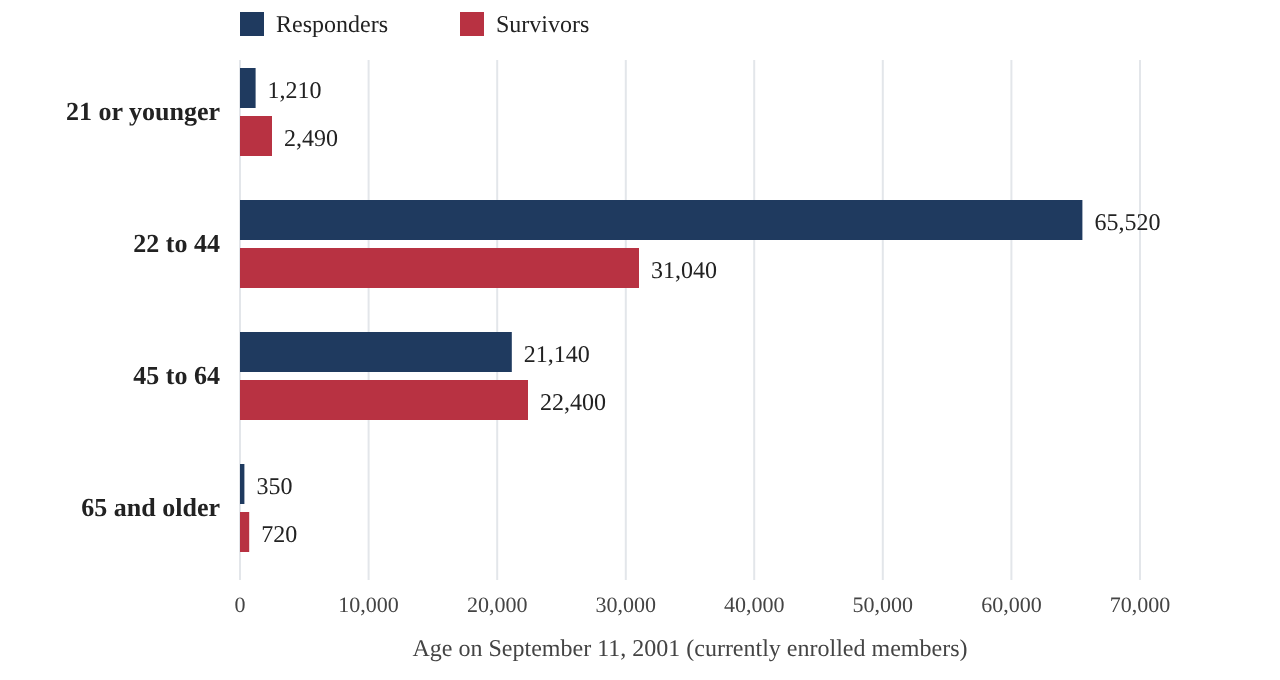
Figure 1. Current WTC Health Program members by age on September 11, 2001. Source: WTC Health Program External Quarterly Program Summary, data through June 30, 2026, Figure 9, published August 1, 2026; the report prints these counts in thousands to two decimal places. Counts currently enrolled members only and excludes deceased and disenrolled members. It does not measure how many young people were exposed or how many may be eligible. Data are preliminary and subject to revision.
New York City has also begun releasing its own records from those months. In September 2026 the city opened a public portal for its 9/11 records, including air testing records, after settling a public records lawsuit brought by the advocacy group 9/11 Health Watch, and the city posted a second batch at the end of October.
When Will Enrollment in the Youth Research Cohort Open?
Enrollment has not opened, and the Program has not announced an opening date. On July 31, 2026, the Program posted a funding forecast for a Youth Research Coordinating Center, the organization that will recruit and enroll the cohort. The forecast lists total program funding of $50 million, an estimated application deadline of February 23, 2027 and an estimated project start date of July 1, 2027. Those dates are estimates and can change. According to the Program, research studies will begin only after enough people have joined. You can sign up for updates on the Program’s Youth Research Cohort page.
Do You Have to Wait for the Cohort to Get 9/11 Health Care?
No. The Youth Research Cohort is a research group and does not provide medical care, while Health Program membership is open now and has no enrollment deadline. The Program calls people who lived, worked or went to school downtown “survivors.” That term does not mean you escaped one of the towers or were downtown on September 11th itself. Under the Program’s eligibility rules, you may qualify as a survivor if you were caught in the dust cloud on 9/11, or if you lived or went to school or day care in the NYC Disaster Area for at least four days between September 11, 2001 and January 10, 2002, or at least 30 days between September 11, 2001 and July 31, 2002, with each day lasting at least four hours. The NYC Disaster Area is Manhattan south of Houston Street and any block in Brooklyn wholly or partly within 1.5 miles of the former World Trade Center site. Our post on WTC Health Program eligibility requirements covers these rules in more detail.
The Health Program covers conditions on its List of WTC-Related Health Conditions, including asthma, chronic rhinosinusitis, gastroesophageal reflux disease, post-traumatic stress disorder and every type of cancer. Any cancer diagnosed before age 20 falls in the List’s childhood cancer category, which our post on 9/11 and childhood cancers discusses. Having a listed condition is not the same as having that condition certified. Certification is an individual decision the Program makes after reviewing your exposure and your medical records.
Which Medical Records Matter Most if You Were Exposed as a Child?
Records from your childhood doctors matter most for breathing and digestive conditions, because the Program requires those symptoms to have started within a set time after your last 9/11 exposure. Under the 2025 Member Handbook, symptoms of asthma and other obstructive airway diseases, and of chronic rhinosinusitis and other upper respiratory diseases, must have begun within five years after the last date of exposure. Reflux disease with no other diagnosed WTC-related condition must have begun within one year. For someone exposed through July 31, 2002, the five-year limit means showing that symptoms started by mid 2007, and the proof is a pediatrician’s chart, a school nurse record or an emergency room visit from those years.
More than 25 years have passed, and those records are getting harder to find, so ask your parents and your childhood doctors’ offices now what still exists. Cancer follows a different rule: a minimum time must have passed after exposure, and every one of those minimums has now passed for anyone exposed in 2001 or 2002.
How Do Former Students Prove They Were There?
School records are the most reliable proof for anyone who went to school downtown. The Health Program’s supporting documentation page lists a student identification card dated between September 11, 2001 and July 31, 2002, a transcript from the fall 2001 or spring 2002 semester, and a letter from your school stating your location during that period.
The VCF treats a certified school record as complete proof of presence on its own. Under Section 1 of its Policies and Procedures, a school or day care record or transcript showing enrollment or attendance must be certified, or come with a letter from a school employee or from your attorney confirming that it is a true and accurate copy. The VCF asks for an official transcript from high school and college students, including students at Borough of Manhattan Community College, and a certified report card or official transcript from elementary and middle school students. Under the VCF’s presence guidance, an attorney’s letter is accepted only when the attorney personally signs it and states that the law office received the record directly from the school. The VCF also lists an email address, info@stuyhealth.org, for alumni of Stuyvesant or any other school in the NYC Exposure Zone who need help getting attendance records.
The school’s location matters, not where you lived. A student who rode the subway from Queens or the Bronx to a high school south of the Canal Street line was in the VCF’s NYC Exposure Zone every school day. Records for a school that has since closed or merged can take months to locate, so start that request first.
How Do People Who Lived Downtown as Children Prove Residence?
Residence is harder to prove for people who were children, because the lease, the deed and the utility bills were in a parent’s name. The Health Program accepts a lease or utility bill with your own name on it, but it also accepts a letter from a resident manager, a neighbor or a school stating where you were, and documents showing that your home received or was eligible for a Lower Manhattan Development Corporation residential grant. If you went to school near home, your school records may prove both.
For the VCF, the presence guidance names the best evidence for people who lived in New York City public housing: income affidavits or salary declarations dated between September 11, 2001 and May 30, 2002. When documents are not available, the VCF accepts its own Witness Presence Statement form. A witness must have been at least 18 on September 11, 2001, except that a high school student may complete one for a classmate. If witness statements are your only proof, you need at least two, and at least one must come from someone who is not related to you. A parent can be one witness, but a neighbor, teacher or family friend will usually be needed as the second.
Can Former Students and Residents Also Get VCF Compensation?
Yes, if you meet the VCF’s separate requirements. The September 11th Victim Compensation Fund is run by the Department of Justice. It requires presence in its NYC Exposure Zone, which for the general public is Manhattan south of the Canal Street line, at any time between September 11, 2001 and May 30, 2002, and a physical condition certified by the Health Program or, in limited cases, verified through the VCF’s private physician process. The VCF requires registration within two years of the most recent Health Program certification of a physical condition, and the deadline to file a claim is October 1, 2090.
The three programs use three different maps and time periods, and Figure 2 sets them side by side. A child who lived on Grand Street or went to school in Brooklyn Heights may qualify for the Health Program and still need separate proof of time spent south of the Canal Street line to qualify for the VCF.
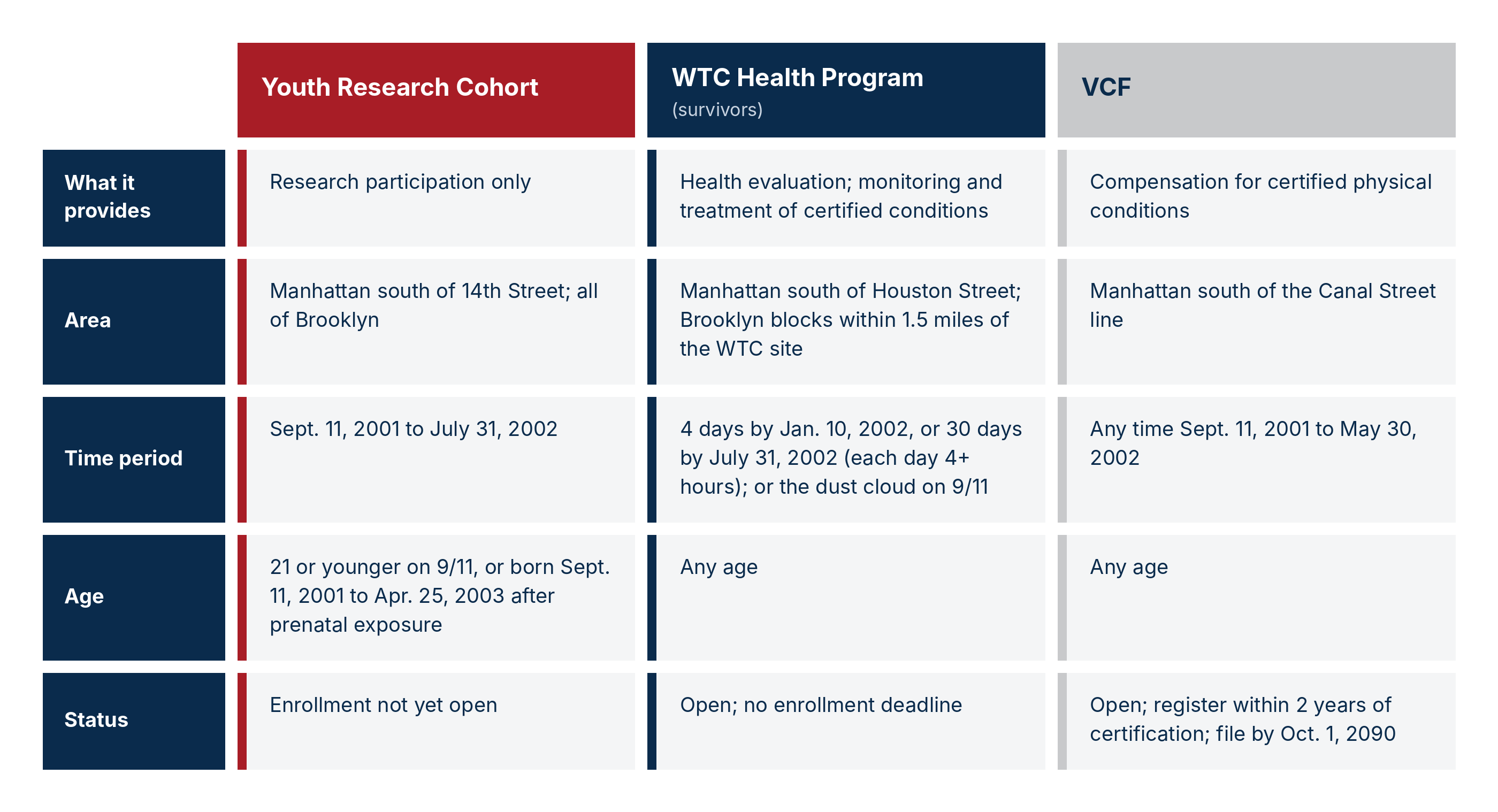
Figure 2. Area, time period and age rules for the Youth Research Cohort, the WTC Health Program and the VCF. Sources: Youth Research Cohort page and December 2025 update; WTC Health Program eligible groups and NYC Disaster Area; VCF NYC Exposure Zone and deadlines, checked November 11, 2026. A summary of the main rules for people who lived or went to school downtown, not a complete statement of eligibility. The official maps and policies control.
How We Help Former Students and Young Residents
Hansen & Rosasco, LLP represents 9/11 responders and survivors in WTC Health Program and VCF matters, including people who were students and young residents downtown. We request school transcripts and other records directly from schools so they can be submitted with an attorney’s verification letter, assemble proof of residence and witness statements, prepare Health Program applications, follow certification requests through the Program, and register and file VCF claims. Medical decisions belong to your doctors, certification decisions belong to the Health Program, and award decisions belong to the VCF. No attorney can guarantee enrollment, certification or an award. This post is general information, and each claim turns on its own facts.
If you went to school or grew up downtown after 9/11 and want to know whether you may qualify, contact Hansen & Rosasco, LLP for a free consultation.