
 800-887-7299
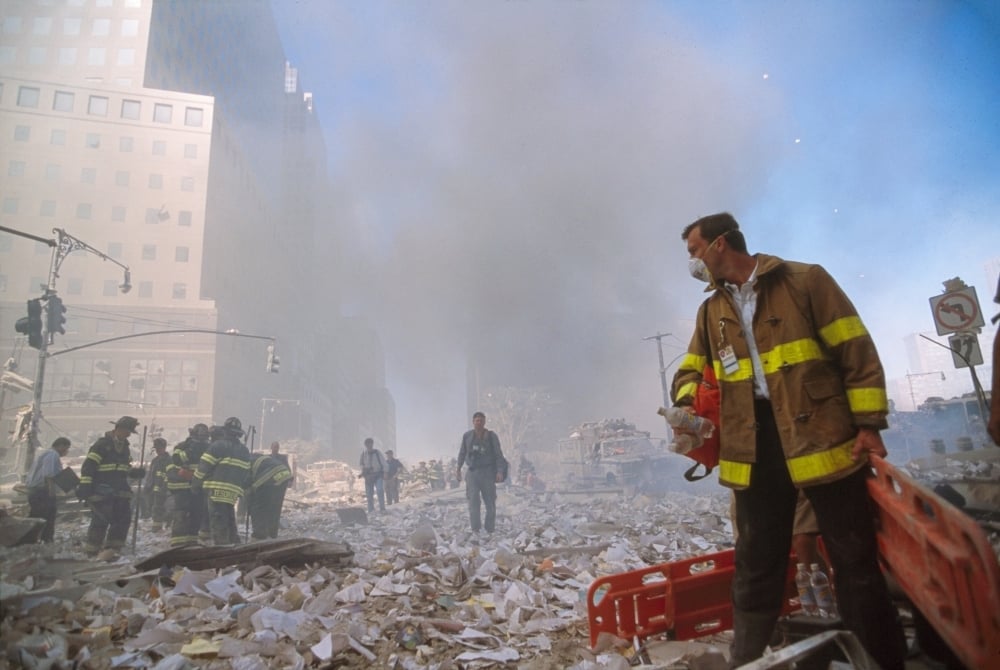
If you lived, worked, or went to school in lower Manhattan in the fall of 2001 or the first half of 2002, and you have since been diagnosed with cancer, a sinus or breathing problem that never cleared up, or reflux that will not go away, you have probably wondered whether the dust and smoke from Ground Zero had something to do with it. Often the question first comes up decades later, when a doctor asks where you were on September 11th.
No blood test, scan, or biopsy can show that one person's tumor came from the 9/11 dust, and the law does not ask you for that kind of proof. Congress and the World Trade Center (WTC) Health Program have already reviewed the science and decided which conditions are linked to the exposures. What you have to prove are your own facts: where you were, when you were there, for how long, what you were diagnosed with, and when the illness started. A Program physician then makes a medical determination, the Program decides whether to certify the condition, and the September 11th Victim Compensation Fund (VCF) accepts that certification as proof of an eligible condition.
Hansen & Rosasco, LLP has handled 9/11 claims since 2001, and we help our clients assemble that proof so they can concentrate on their health.
Can a Doctor Tell Whether the 9/11 Dust Caused My Cancer?
No. A doctor cannot tell from an examination or a test whether the 9/11 dust caused one person's cancer. Most illnesses have more than one possible cause, so the link between an exposure and a disease is established by studying large groups of exposed people over many years. Those studies have been done for the 9/11 community. In 2012 the Program's Scientific/Technical Advisory Committee reviewed roughly 70 known and potential carcinogens found in the dust and smoke, and a final rule published September 12, 2012 added cancers to the List of WTC-Related Health Conditions effective October 12, 2012. Since January 18, 2023, every type of cancer has been on the List. It also includes chronic rhinosinusitis, asthma, COPD, interstitial lung disease, GERD, sleep apnea, PTSD, depression, anxiety disorders, and other conditions.
If your condition is on the List, the Program has already accepted that 9/11 exposures can cause it. What gets decided in your own case is whether your exposure, and the timing of your illness, meet the Program's rules.
What Standard Does the WTC Health Program Apply?
The test comes from the Zadroga Act. A Program physician must find that your 9/11 exposure is "substantially likely to be a significant factor in aggravating, contributing to, or causing" the condition. The Program then reviews that determination and certifies the condition, denies it, or suspends the request for more information.
Three parts of that wording help applicants. First, 9/11 exposure has to be a significant factor in the illness, not the only cause. Second, "aggravating" means a condition you had before September 11th can qualify if the exposure made it worse. Third, the decision is a medical judgment made under the Program's written policies. You do not have to win a trial.
Being on the List does not mean automatic approval. The 2012 rule states that a condition's place on the List "does not guarantee that a particular individual's condition will be certified." Having a listed condition is not the same as having that condition certified. The Program still reviews each person's exposure and medical records.
What Facts Do I Actually Have to Prove?
The Program's February 20, 2015 certification policy has physicians weigh the location, intensity, and duration of exposure, along with the symptoms and their timing. In practice, that means four kinds of proof.
1. Where you were
For New York, the Program's Disaster Area is Manhattan south of Houston Street and any block in Brooklyn wholly or partly within 1.5 miles of the former World Trade Center site. People who were not responders are enrolled as "survivors." That term does not mean you had to escape one of the towers or be downtown on September 11th itself. It covers anyone caught in the dust cloud that day, and anyone who lived, worked, or went to school in the Disaster Area for at least four days between September 11, 2001 and January 10, 2002, or at least 30 days through July 31, 2002 (see the CDC's eligibility page). Leases, utility bills, school records, and pay stubs are the usual proof.
2. How heavy the exposure was, and for how long
The 2015 policy sorts exposure into three tiers. Tier 1 includes being caught in the dust cloud and living, working, or attending school in heavily dust-contaminated areas or in the path of heavy smoke plumes. Tier 2 covers places with a visible but light layer of dust, or where you could smell smoke or chemicals. Tier 3 covers places with no visible dust and no smell of smoke or chemicals, and time spent only traveling through the area. Figure 1 shows the hours that satisfy the policy.
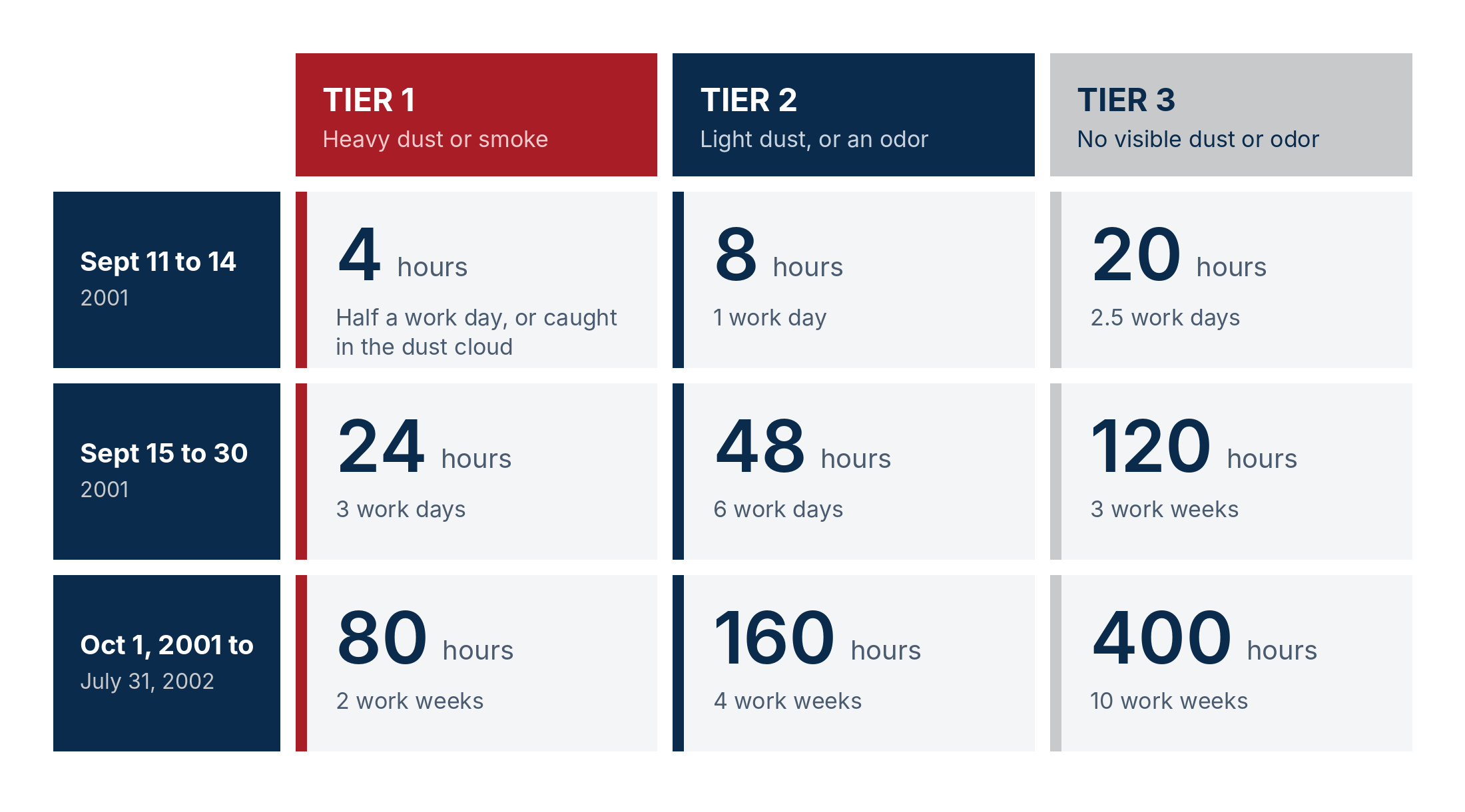
Figure 1. Hours of exposure that meet the WTC Health Program's certification policy, New York City area sites. Source: WTC Health Program, Policy and Procedures for Certification of Physician Determinations for Aerodigestive and Cancer Health Conditions (February 20, 2015), Tables 1 and 4. Work-week equivalents assume 8-hour days and are added for illustration. The thresholds apply to aerodigestive and cancer certifications, not to enrollment or mental health conditions. A case below these figures is not disqualified; the Program reviews it individually.
The required hours are lower than many people expect. Two ordinary work weeks (80 hours) in a heavily dust-contaminated office after October 1, 2001 meet the Tier 1 standard, and being caught in the dust cloud on September 11th meets it by itself. The policy also says that a lack of visible dust, smoke, or odor does not automatically mean a location was free of contamination.
3. What you were diagnosed with
The diagnosis has to appear in medical records. Every cancer certification request must include a pathology report. For other conditions, the Program's Diagnostic Essentials guidance lists the history, examination findings, and test results that support each diagnosis, such as a sinus CT scan for chronic rhinosinusitis.
4. When it started
The timing rules for cancer are different from the timing rules for breathing and digestive conditions. Cancer has a minimum waiting period, called latency. Breathing and digestive conditions have a maximum time limit.
For cancer, a minimum amount of time must have passed between your first 9/11 exposure and the date of diagnosis for the cancer to be certified, because cancer does not develop immediately after an exposure. The Program's minimum latency policy, last revised in 2025, sets 146 days for leukemia, lymphoma, and other blood cancers, 2.5 years for thyroid cancer, 4 years for other solid cancers, 11 years for mesothelioma, and 1 year for other cancers diagnosed before age 20. More than 25 years after the attacks, a cancer diagnosed today meets every one of those minimums. The latency rule now matters mainly for cancers that were diagnosed in the first years after 9/11.
For breathing and digestive conditions, the rule is the opposite. Symptoms must have started within a maximum period after your last 9/11 exposure: five years for asthma, chronic cough, chronic rhinosinusitis, and similar airway conditions, five years for GERD that occurs along with one of them, and one year for GERD on its own, according to the 2025 Member Handbook. COPD and interstitial lung disease have no maximum.
More than 25 years have passed since 9/11, and the passage of time is making it harder to get acceptable proof of when your symptoms began. The Program's Administrative Manual accepts three kinds of proof, in this order of preference: first, medical records made at the time showing that the symptoms began within the time limit; second, if those records are gone, a signed letter from your treating physician explaining how the onset date was determined and why the old records are unavailable; third, if neither exists, the records of your first Program examination. If you had the condition before September 11th, the records must show that it got worse within the same time limit, for example through more frequent or more intensive treatment.
What If I Smoked, or Cancer Runs in My Family?
Smoking or a family history of cancer does not automatically disqualify you. The standard asks whether 9/11 exposure was a significant factor, not whether it was the only cause, so the Program physician weighs a smoking history or a family history along with the rest of your medical records. The VCF's eligibility criteria do not mention smoking at all. Give your doctors and the Program a complete and accurate history. A risk factor that was left out and later turns up in the records raises questions that are easier to answer at the beginning.
Which 9/11 Conditions Are Being Certified Most Often?
Cancer is now the condition the Program certifies most often. In the twelve months ending June 30, 2026, the Program reported 10,393 cancer certifications, according to its quarterly program summary. The eleven other conditions listed in that report totaled 6,897 combined, led by GERD (1,553) and chronic rhinosinusitis (1,410). Survivors received 5,762 of the cancer certifications and responders 4,631. Over the life of the Program, cancer leads all categories with 57,044 certifications, ahead of chronic rhinosinusitis (42,372) and GERD (39,190), and 67.3 percent of the 145,275 people currently enrolled hold at least one certified condition.
Cancer leads because of the timing rules and the age of the members, not because the rules changed. Breathing and reflux conditions generally had to begin within one to five years of the last exposure, while new cancers continue to be diagnosed as members get older. About half of current members are now 65 or older.
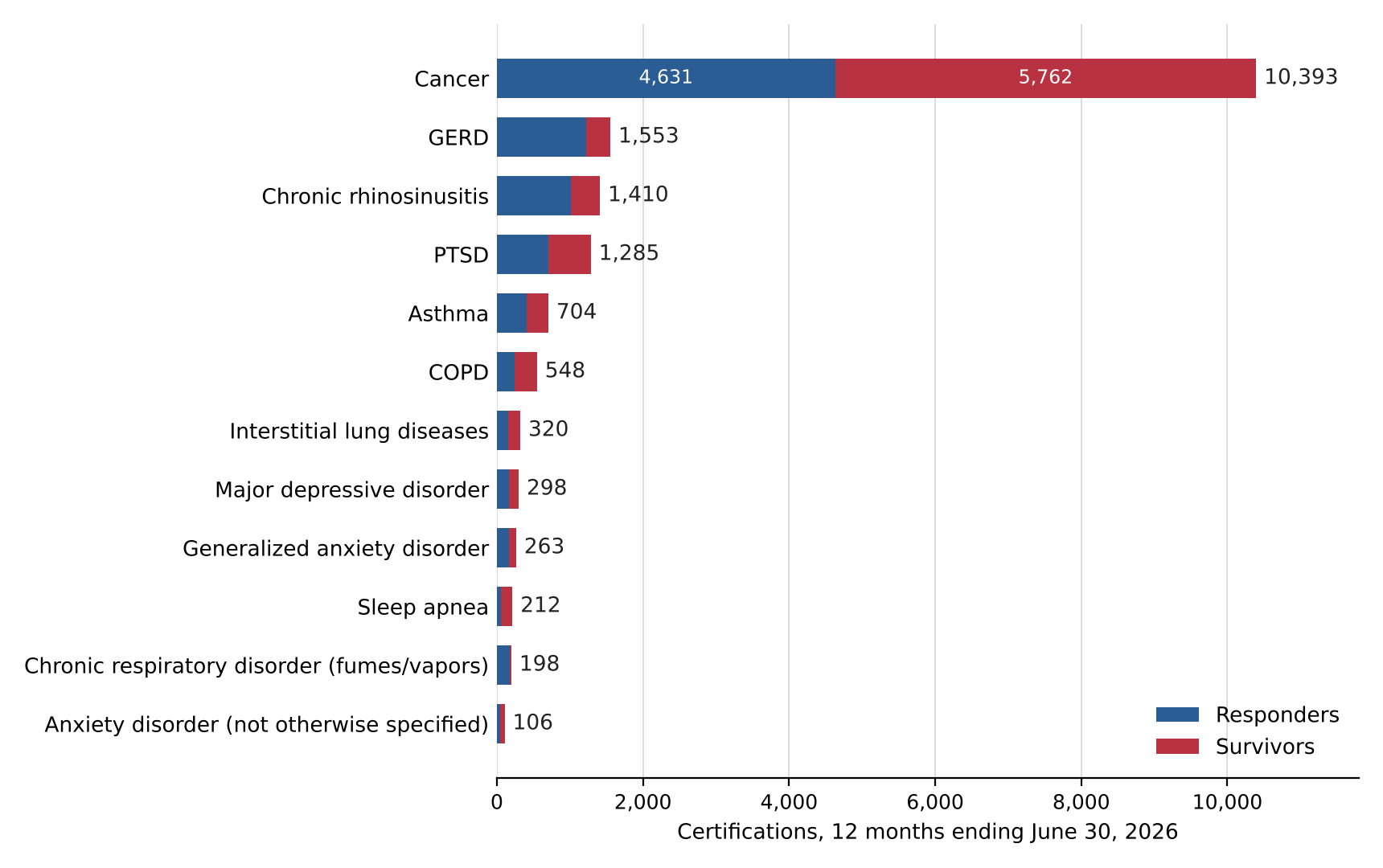
Figure 2. Health conditions certified by the WTC Health Program in the 12 months ending June 30, 2026, by member type. Source: CDC, WTC Health Program External Quarterly Program Summary, data through June 30, 2026, Figure 40. Counts are certifications, not people; one member can hold several. Conditions with fewer than 10 certifications for a member type are not reported. These figures do not measure anyone's risk of disease. Data are preliminary and subject to revision.
How Does WTC Health Program Certification Carry Over to a VCF Claim?
For most claimants, the Program's certification is what proves the medical condition to the VCF. The VCF accepts a Program certification of a physical condition as proof of an eligible condition, subject to its other requirements, and you do not need to send more records just to establish the condition. The VCF receives only the condition, its category, and the diagnosis code, not your Program records, so your own medical records still matter if the condition affects you more seriously than the certification shows.
Presence is proved separately, and the VCF's area is smaller than the Program's. The NYC Exposure Zone is the area of Manhattan south of the Canal Street line, at any time from September 11, 2001 to May 30, 2002. Someone who lived between Canal and Houston Streets may be certified by the Program and still need to show time spent south of the Canal Street line, generally through two documents or the VCF's own Witness Presence Statement form. The VCF also compensates only physical conditions, so a certified mental health condition such as PTSD does not on its own support an award.
A narrow Private Physician process lets the VCF evaluate a condition without certification in limited cases, such as a claimant who died before being certified. Registration and filing deadlines also deserve attention, and the VCF explains them on its eligibility and deadlines page.
What If the Program Asks for More Information or Denies Certification?
A suspended request is not a denial. It means the Program has asked the clinic for missing or clarifying information, and the clinic has 60 days to supply it. Use that time to get the exposure details or records the Program asked for into the file.
A denial can be appealed by a written, signed request postmarked within 120 calendar days of the date of the denial letter. An appeal can correct factual errors, add new information, or show that the Program misapplied its policies, but it cannot challenge the List itself or a policy that applies to all members. If your condition is not on the List, an appeal cannot add it. The only route is a petition asking the Program to add the condition, which the Program decides on the scientific evidence.A denial can be appealed by a written, signed request postmarked within 120 calendar days of the date of the denial letter. An appeal can correct factual errors, add new information, or show that the Program misapplied its policies, but it cannot challenge the List itself or a policy that applies to all members. If your condition is not on the List, an appeal cannot add it. The only route is a petition asking the Program to add the condition, which the Program decides on the scientific evidence.
Does New York Workers' Compensation Accept Certification as Proof?
Yes, for workers' compensation claims by people who took part in rescue, recovery, and cleanup operations. Since September 2022, Section 169 of the Workers' Compensation Law has required the Board to accept Program certifications as presumptive evidence of causation for claims filed under Article 8-A. A presumption can be rebutted with other evidence, so certification supports the claim but does not decide it by itself.
Get Help Proving the Connection
Proving that the 9/11 air caused an illness comes down to proving where you were in 2001 and 2002 and when your illness began, often with records that are more than 20 years old or no longer exist. That is the work we do. Our attorneys and our dedicated paralegal team focused on WTC Health Program certification handle exposure histories, missing records, and witness statements, and coordinate between the Program and the VCF. The medical determination remains with the Program's physicians, and certification remains with the Health Program. No attorney can guarantee approval, but careful preparation and follow-through matter.
If you believe your cancer or illness may be connected to your time in lower Manhattan after September 11th, contact Hansen & Rosasco, LLP for a free consultation. You do not need to come to our office or even be in New York to work with us.