
 800-887-7299

Your former employer may be gone, but that does not necessarily mean your opportunity to claim 9/11 benefits is gone with it. The September 11th Victim Compensation Fund (VCF) expressly recognizes that old records may no longer exist or may be impossible to obtain. Other evidence may establish qualifying presence, but it still has to meet the Fund's requirements.
For someone facing a cancer diagnosis or another illness, trying to prove where they worked twenty-five years ago can feel overwhelming. At Hansen & Rosasco, LLP, we help clients identify available evidence, address missing records, and obtain appropriate supporting statements. The employer's closure is a reason for careful evidence work, not an automatic disqualification.
Why the VCF Still Requires Proof of Presence
To compensate someone for a 9/11-related illness, the VCF must confirm presence at a qualifying location during the applicable period. It also generally requires a physical condition certified by the World Trade Center Health Program, with a limited alternative verification process in certain circumstances. Certification does not establish every other requirement for compensation.
Dr. John Howard's 2012 cancer determination established a scientific basis for adding dozens of cancers to the Health Program's covered conditions. An applicant does not have to establish that scientific basis all over again. But a covered diagnosis is not a substitute for the individual medical review or the evidence showing that person's qualifying exposure.
The two programs also apply different geographic boundaries, exposure periods, and standards. The VCF does not set a minimum time at a site for confirming presence. The Health Program separately evaluates exposure, including its location, intensity, and duration. Being accepted by one program does not automatically establish eligibility for the other.
Twenty-Five Years Is a Long Time for Records to Survive
A business may have closed, merged, changed ownership, or moved. Its old personnel files may no longer be available. A small employer may have kept limited records in the first place, and former supervisors or coworkers may now be difficult to locate.
The Health Program's minimum-latency policy recognizes that cancers can take many years or decades to become apparent. That means the need for a 9/11 claim may arise long after an employment relationship has ended. A missing payroll file does not, by itself, mean there is no evidence of where someone worked.
People are still coming forward. The Health Program's June 2026 report records 11,199 enrollment applications received in 2025. These are applications, not approvals, and the report does not identify which applicants lacked employment records.
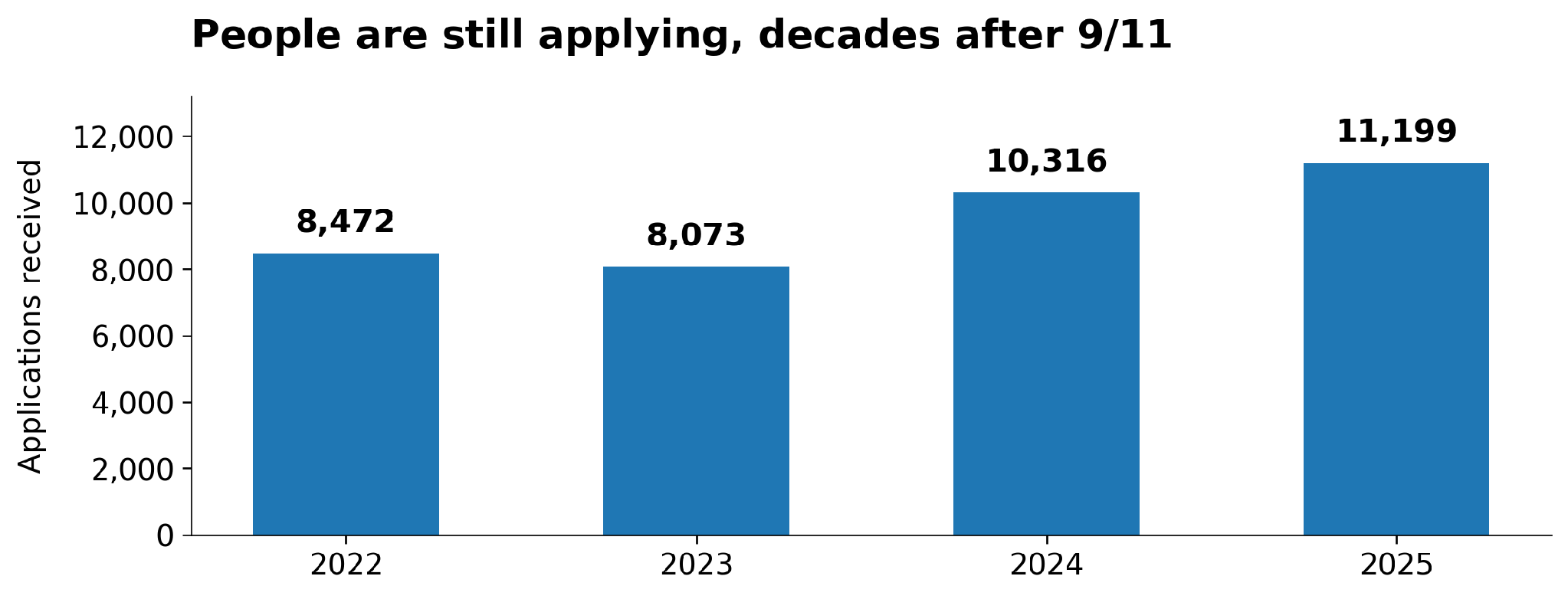
Figure 1. Enrollment applications received in calendar years 2022–2025, combining responder and survivor counts. Not approvals, VCF claims, or a closed-employer subset. Source: WTC Health Program June 30, 2026 quarterly report, Figure 12. Data are preliminary and subject to revision.
Not Every Old Work Record Proves Where You Were
The VCF gives particular weight to third-party verification and records created at the time. It also has arrangements with certain employers, unions, and other organizations to provide presence information. Our work includes determining whether useful verification remains available, even when the original employer cannot supply its own records.
The important question is what a document actually establishes. A pay record may confirm employment or earnings without showing that the employee physically worked at a particular location during the relevant period. The VCF specifically describes pay stubs as evidence to be considered with other documents showing physical presence. An employer's mailing address is not necessarily the employee's worksite.
The VCF considers the totality of the circumstances and a range of evidence, subject to independent verification. We review the material as a whole, rather than treating every old document as equally useful. The purpose is to connect the client's actual history to the requirements that apply, not simply assemble a larger stack of papers.
Witness Evidence Can Be Essential, but the Requirements Are Strict
When primary records cannot be obtained, the VCF may consider sworn Witness Presence Statements. These statements must be sufficiently detailed and reliable. A witness must have personal knowledge of the claimant's presence; knowing that someone worked for a downtown company is not necessarily enough.
For newly prepared witness evidence, the VCF requires its prescribed Witness Presence Statement rather than a general affidavit. Its transition rule permits affidavits signed and dated before February 1, 2023, although their substance still needs to establish presence. The Health Program has its own documentation and attestation requirements. These are not interchangeable, and a signature alone does not resolve an incomplete account.
Our attorneys and staff help identify appropriate witnesses and review the supporting statements for gaps or unexplained inconsistencies. The VCF says it will not call a witness simply to collect missing detail. The account must remain truthful and reflect what the witness actually knows. Uncertainty should be addressed honestly, not replaced with guesses or details the witness cannot support.
Your Own Statement and Photographs Have Limits
Your account can help explain your history and provide context. But the VCF's rule is explicit: a written Victim Presence Statement, an impact statement, or photographs, alone or in combination without acceptable supporting proof, are not sufficient. A claim relying only on those materials will be procedurally denied for lack of proof of presence. This is more than a preference for stronger documentation.
The Health Program's rules differ. Its supporting-documentation guidance permits a first-party attestation in specified circumstances when official documentation and a third-party attestation cannot be obtained. That provision does not change the VCF's separate requirements. Our team reviews the evidence needed for each program rather than assuming that acceptance by one resolves the other.
Explaining Missing Records Is Not the Same as Proving Presence
The reason records cannot be obtained can matter. For certain listed employers and unions, the VCF requires efforts to obtain available verification before it will rely on witness statements. Our attorneys address those requirements and help explain unsuccessful efforts when the expected records are unavailable.
A company's closure may explain why its payroll files cannot be produced. It does not establish that a particular employee was physically present at a qualifying location. Both issues need attention: why the original records are missing and what reliable evidence supports the person's presence.
What to Do If an Application Has Stalled or a Claim Has Been Denied
The Health Program's Administrative Manual distinguishes an application suspended for incomplete or insufficient documentation from an enrollment denial. A suspension means more information is needed to continue the process. It is not an approval, and it should not be mistaken for a final rejection.
The VCF likewise explains that a denial for lack of proof of presence does not necessarily mean it disbelieves the claimant. It can mean that the evidence did not meet its requirements. In some cases, an eligibility hearing provides an opportunity to give testimony and answer questions about presence. Our attorneys evaluate whether additional review or an appeal is appropriate for the particular decision.
Our goal is to address known evidentiary problems before filing, not assume they can simply be repaired after a denial. When a problem arises, we review the notice, the available evidence, and the appropriate response while protecting the client's review and appeal rights.
A Records Search Should Not Put Your Deadlines at Risk
The VCF has separate registration and claim-filing deadlines. Registration does not require a certified condition, and it is not the same as submitting a completed claim. Health Program enrollment does not automatically register someone with the VCF.
There is no deadline to enroll in the Health Program, but that does not eliminate a person's VCF deadlines. Our team considers timing alongside the records search so an unresolved documentation issue does not distract from protecting the client's rights.
Preserving Evidence Is Not the Same as Approval
The VCF encourages people to preserve presence evidence before they become ill. But storing documents in a VCF file does not mean the Fund has accepted them. The VCF does not review stored materials for sufficiency until the completed claim and required supporting documents are submitted. We help clients preserve useful evidence without treating storage as an eligibility decision.
How Hansen & Rosasco Helps With Missing Employment Records
At Hansen & Rosasco, LLP, we maintain a dedicated paralegal team focused on WTC Health Program certification. Our attorneys and staff help with enrollment, the evidence supporting certification, and separate VCF claims. When an employer is no longer available, that work includes evaluating other records, seeking appropriate verification, and assisting with witness evidence.
An attorney is not required to apply. Our role is to provide legal guidance and follow-through when the proof is difficult to obtain or the programs' different requirements are not being met. The medical determination remains with the Program's physicians; we address the evidence and administrative issues that can stand in the way.
Our goal is to keep a valid claim from being delayed, suspended, or denied because of a missing record, an inadequate witness statement, or an unexplained inconsistency that could have been addressed before filing. No attorney can guarantee approval, but careful preparation and follow-through matter.
If your former employer no longer exists, do not assume your claim ended with it. Contact Hansen & Rosasco for a free consultation. Let us help with the documentation and government process so you can concentrate on your health.