
 800-887-7299

A denial from the September 11th Victim Compensation Fund (VCF) can be upsetting, particularly when you are already dealing with cancer or another serious illness. But a denial does not always mean the VCF has decided that you were not exposed or that your illness is unrelated to September 11. Sometimes the claim cannot move forward because required documents are missing. In other cases, the evidence has been reviewed and an eligibility requirement has not been established.
The distinction matters. The reason stated in the decision letter determines what needs attention. At Hansen & Rosasco, LLP, we help clients address those problems, develop the necessary evidence, and protect their rights to further review. Our aim is also to identify avoidable problems before a claim is submitted.
What Are the Two Types of VCF Denials?
Procedural Denials
A procedural denial concerns the information needed to process the claim. The VCF's preliminary-review guidance explains that a claim can be placed in Denied status when required documents are missing or insufficient. This can happen before the Fund has completed a substantive review of eligibility. A missing signature, inadequate authorization, or absent proof of presence is not simply a clerical detail when it prevents review from proceeding.
Providing what is missing may allow review to resume. It does not establish that the claim will ultimately be approved.
Substantive Denials
A substantive denial follows a review of whether the evidence establishes eligibility. Under Section 1.12 of the VCF's policies, that review includes qualifying presence, an eligible physical condition, timely registration, and compliance with the rules concerning 9/11-related lawsuits. The same subject can arise at different stages: submitting no acceptable presence evidence is different from submitting evidence that is reviewed but does not establish qualifying presence.
Not every problem leads to another request for information before a denial. The notice and the record need to be reviewed together, rather than assuming that every Denied status means the same thing.
What the VCF's Own Data Shows
The VCF's August 2026 Monthly Statistics Report lists 15,393 procedural denials and 2,838 substantive denials as of August 31, 2026. These are counts in the reported categories, not the number of new denials issued during a single year.
The separate July 31, 2026 Premature and Insufficient Claims Summary Report lists 4,435 procedural denials for claims submitted from 2024 through its report date. It tracks a different group of claims and should not be combined with the monthly denial totals.
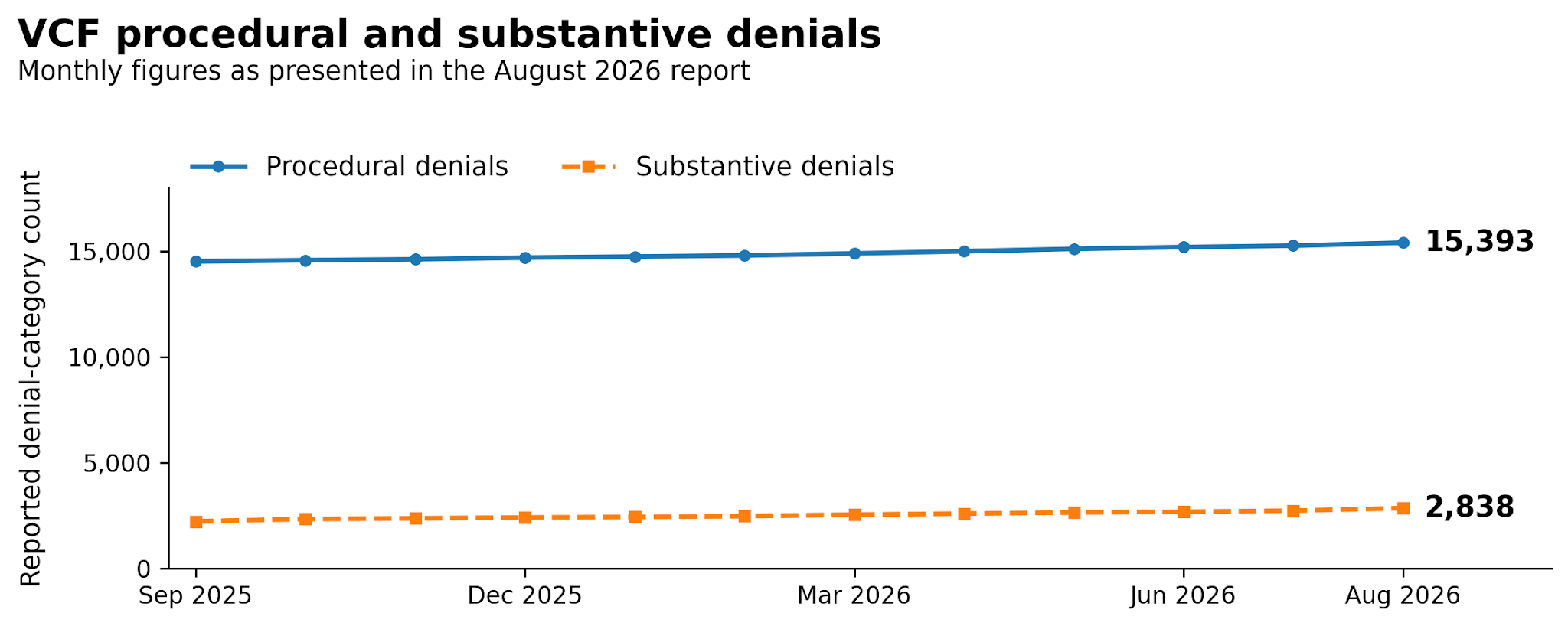
Figure 1: Monthly denial-category counts as presented in the VCF's August 2026 Monthly Statistics Report, page 5, for September 2025 through August 2026. These are not newly issued denials, denial rates, or final outcomes. Returned-for-review categories are reported separately. Earlier figures may be revised. Sources: August 2026 report and report definitions.
Neither report shows that a denied claim will later be approved. Returning a claim to review is not the same as receiving an award. The figures illustrate why the reason for a denial matters; they do not tell us which response will succeed in an individual case.
Why Claims Can Be Denied or Delayed
No Certified Physical Condition
A diagnosis, enrollment in the World Trade Center Health Program, and certification of a condition are different things. For an illness claim, the VCF generally relies on Health Program certification of an eligible physical condition, with a limited Private Physician process available in specified circumstances. An appointment with the Health Program is not the same as a certification decision. Its Administrative Manual makes that distinction clear. The VCF confirms certification directly with the Health Program.
Dr. John Howard's 2012 cancer determination established the basis for adding dozens of cancers to the covered conditions. An applicant does not have to establish that scientific basis all over again. But the rule retained individual medical review and certification. His exposure policy also requires consideration of the location, intensity, and duration of exposure. A covered cancer is not a substitute for that individual assessment.
Missing or Insufficient Proof of Presence
Proof of presence is not limited to work on the debris pile at Ground Zero. The evidence must establish presence at a qualifying location during the applicable period. The VCF and Health Program use different geographic boundaries, exposure periods, and standards. Acceptance by one does not automatically establish eligibility for the other.
The VCF gives particular weight to third-party verification and records created at the time. But twenty-five years later, employers may have closed, records may have disappeared, and former coworkers may be difficult to locate. Even an available payroll record may establish employment without establishing where someone physically worked.
When records are incomplete, witness evidence can be essential. Newly prepared VCF witness evidence must use the prescribed Witness Presence Statement rather than a general affidavit; the policy separately addresses affidavits signed before February 1, 2023. The statement still needs reliable, specific information based on the witness's knowledge. The VCF will not interview a witness simply to supply details omitted from the statement.
The limits on a claimant's own account and photographs are equally important. A claim supported only by a Victim Presence Statement, an impact statement, photographs, or a combination of those materials will be procedurally denied without acceptable supporting proof. The Health Program's separate attestation provisions do not change that VCF rule. Our attorneys help address these gaps without asking clients or witnesses to guess at facts they cannot support.
Registration and Filing Deadlines Are Confused
The VCF's registration deadline and claim-filing deadline are different. Registration does not require a certified condition, and Health Program enrollment does not automatically register someone with the VCF. A cancer diagnosis date is not automatically the date that starts the registration period. Government determinations that an illness is 9/11-related, prior registration, and the circumstances of a deceased claim can affect the analysis.
A timing problem should not be treated as a missing attachment that can simply be supplied later. Our team reviews the applicable deadlines alongside the medical and presence evidence.
The Medical Record Does Not Establish the Claimed Condition or Timing
A reference to a possible diagnosis is not the same as a confirmed condition. The Health Program's Diagnostic Essentials guidance identifies the medical evidence used to substantiate different conditions. The question is not just whether records were supplied, but whether they establish what the claim requires. We also check that the condition claimed matches what has actually been certified; certification of one illness does not cover every diagnosis in the records.
The Health Program's March 31, 2025 minimum-latency policy measures the interval from initial exposure to the initial cancer diagnosis. Its minimums are not deadlines by which cancer must appear. A diagnosis decades later should not be dismissed because the exposure was long ago, but a diagnosis before the applicable minimum presents a different issue. These medical-certification requirements remain separate from the VCF's other eligibility requirements.
Required Forms or Authority to Act Are Missing
The VCF must have the required signatures and authorizations, not simply an online form marked submitted. Where someone files for a deceased person or an incapacitated adult, the Fund must also validate that person's legal authority. Being a spouse, child, or other close relative does not, by itself, establish authority to pursue the claim.
Our review includes whether documents are complete, properly executed, and appropriate to the claim. Uploading a document is not the same as establishing that it is sufficient.
A Wrongful Death Claim Needs Additional Medical Proof
A person may have had an eligible 9/11-related illness without that illness having caused or contributed to the death. A wrongful death claim requires evidence of that connection. The medical cause of death and the representative's authority are separate issues, and both need attention.
Where the death certificate does not provide enough information, the final medical records or a treating physician's explanation may be important. A lack of support for wrongful death losses also does not necessarily resolve whether there is a claim for the person's eligible losses while alive. Our attorneys review those distinctions with the family rather than assuming that every deceased claim presents the same issues.
What to Do If Your VCF Claim Was Denied
A denial deserves prompt review, but an appeal is not the correct response to every denial. The VCF's Amendments and Appeals guidance distinguishes challenging a determination already made from seeking a new determination based on new information. Newly available presence evidence or a later certification may call for an amendment. A disputed determination, or a case in which testimony is needed to establish eligibility, may call for an appeal.
The choice can affect review and appeal rights. An amendment is not a substitute for protecting an available appeal, and an appeal should not be used merely to obtain faster consideration of unrelated new information. The decision letter and the evidence already submitted need to be assessed together. Appeal deadlines run from the decision letter, and an invalid appeal can result in the loss of the right to challenge that determination.
The VCF's amendment instructions also require a response directed to the reason the claim was denied. Sending more documents without addressing that reason does not necessarily restart the review. We help determine the appropriate response and follow through on the required submission.
When records and witnesses cannot be found despite genuine efforts, the VCF recognizes that testimony may be necessary. That possibility deserves careful legal review; it is not a guarantee of a hearing or an award. A Health Program suspension or certification denial, meanwhile, belongs to that Program's separate review process, not the VCF appeal process.
How Hansen & Rosasco Helps Protect a Claim
At Hansen & Rosasco, LLP, we maintain a dedicated paralegal team focused on WTC Health Program certification. Our attorneys and staff help clients with enrollment, the evidence supporting certification, and their separate VCF claims. That work includes locating difficult-to-obtain records, assisting with appropriate witness statements, addressing missing-information requests, and evaluating amendments and appeals.
The medical determination remains with the Program's physicians. Our role is to address the evidence and administrative requirements that can otherwise stand in the way. A claim needs more than a submission date; it needs the proof required for a meaningful review.
Our goal is to keep a valid claim from being delayed, suspended, or denied because of a missing record, an inadequate witness statement, or an unexplained inconsistency that could have been addressed before filing. No attorney can guarantee approval, but careful preparation and follow-through matter.
If your claim has been denied or has stopped moving forward, contact Hansen & Rosasco for a free consultation. Let us help with the documentation and government process so you can concentrate on your health.