
• 9/11 Victim Programs
  • Victim Compensation Fund (VCF)
  • WTC Health Program (WTCHP)
  • Wrongful Death VCF Claims

The 9/11 Exposure Zone Defined

When filing a claim for compensation with the September 11th Victim Compensation Fund (VCF), one of the first eligibility questions is whether the victim was present at an eligible location during the applicable period. The VCF uses the term NYC Exposure Zone for a defined part of Lower Manhattan and separately recognizes several other eligible 9/11-related locations.

The attacks released dust, smoke, and debris at the crash sites and across parts of Lower Manhattan. In New York, contaminated material also moved along debris-removal routes and to locations such as the Fresh Kills landfill. Understanding the program-specific boundaries matters because the VCF and the World Trade Center Health Program use different geographic, time, and duration requirements.

What Is the 9/11 Exposure Zone?

The VCF does not use one “9/11 Exposure Zone” that encompasses all three crash sites. Instead, it separately recognizes the World Trade Center site and NYC Exposure Zone, the Pentagon site, the Shanksville site, specified debris-removal locations and routes, qualifying Office of the Chief Medical Examiner and morgue locations, and locations used to repair, clean, or rehabilitate vehicles or equipment contaminated by WTC-related debris.

Presence is only one part of VCF eligibility. A claimant must also satisfy the VCF’s other requirements, including having an eligible 9/11-related physical injury or condition and meeting applicable deadlines. The WTC Health Program is a separate program with its own enrollment and certification rules.

VCF NYC Exposure Zone and WTC Health Program NYC Disaster Area

The VCF and WTC Health Program are separate programs. Their New York maps and presence requirements are not interchangeable:

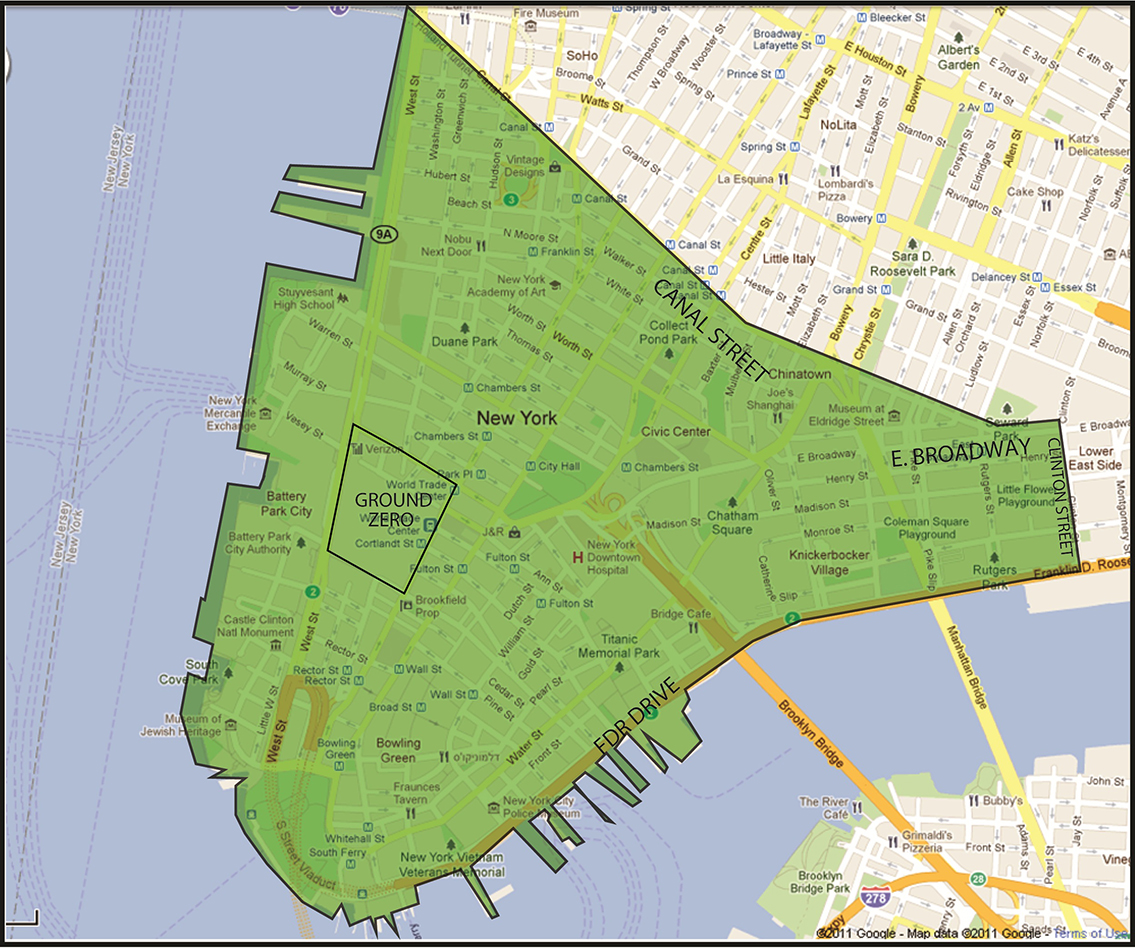
  1. VCF NYC Exposure Zone: The VCF defines this zone as the part of Manhattan south of a line running along Canal Street from the Hudson River to East Broadway, north on East Broadway to Clinton Street, and east on Clinton Street to the East River. It also recognizes areas related to or along debris-removal routes, such as barges and the Fresh Kills landfill, but only for people who loaded, unloaded, or drove trucks carrying WTC debris, worked on the barges, or worked at Fresh Kills. The VCF covered period for the World Trade Center site and NYC Exposure Zone is September 11th through May 30, 2002.

  2. WTC Health Program NYC Disaster Area: For survivor eligibility, this area includes Manhattan south of Houston Street and any block in Brooklyn wholly or partly within a 1.5-mile radius of the former World Trade Center site. The Program separately applies responder eligibility areas and group-specific requirements. Eligibility depends on the person’s activity, location, time period, and hours. For example, presence in the dust or dust cloud in the NYC Disaster Area on September 11th, has no minimum-hour requirement, while people who worked, lived, attended school, or attended child or adult day care generally must meet minimum day-and-hour thresholds.

Exposure Zone Boundaries and Map

The shaded area below shows the VCF’s NYC Exposure Zone. The special rules for debris-removal routes and other eligible locations are not fully represented by the Lower Manhattan map.

NYCExposureZone-resized

Other Qualifying VCF Locations Beyond Lower Manhattan

For VCF purposes, eligible locations also include the following:

  • The Pentagon site: Individuals present at the Pentagon site during the VCF’s covered period may meet the location requirement; the VCF’s other eligibility requirements still apply.

  • The Shanksville site: Individuals present at the Shanksville, Pennsylvania, site during the VCF’s covered period may meet the location requirement; the VCF’s other eligibility requirements still apply.

  • Qualifying OCME and morgue locations: This includes locations used by employees of the New York City Office of the Chief Medical Examiner who examined or handled human remains, and locations used by morgue workers who performed similar functions for OCME staff.

  • Contaminated vehicle and equipment locations: This includes locations used to repair, clean, or rehabilitate vehicles or equipment contaminated by WTC-related debris.

What Are the Covered Time Periods

For VCF presence, the covered period varies by location:

  • The World Trade Center site or the surrounding NYC Exposure Zone from September 11th through May 30, 2002;
  • The Pentagon site from September 11th through November 19, 2001; or
  • The Shanksville, Pennsylvania, site from September 11th through October 3, 2001.

The VCF does not impose a minimum amount of time at a site for purposes of confirming presence. Do not confuse that rule with WTC Health Program eligibility, which can include group- and activity-specific minimum-hour or minimum-day requirements.

How Do You Prove You Were in an Eligible Location

Most claimants prove presence through third-party verification or contemporaneous records. The right documentation depends on why the person was at the eligible location and what records are available. Examples include:

  • Employer, organization, or union verification that gives specific dates and locations;
  • Official personnel rosters, responder dispatch records, or union shop-steward records showing dates and work locations;
  • Pay stubs listing an employer’s address in the NYC Exposure Zone, when combined with other records showing the person physically worked there;
  • Government, rental, mortgage, rent-payment, or utility records showing a residence in the NYC Exposure Zone, combined with other evidence that the person was physically present there;
  • Certified school or day-care records confirming enrollment or attendance during the relevant period; and
  • VCF Witness Presence Statements when primary evidence is unavailable, subject to the VCF’s form and witness requirements.

The VCF’s Interactive Presence Guide explains what documentation to submit based on individual circumstances. Section 1.9 of the VCF Policies and Procedures also lists employers, entities, and unions for which the VCF has specific verification instructions. When a claimant relies on contemporaneous documents rather than direct third-party verification, the VCF generally requires at least two. If primary evidence is unavailable, the VCF may consider detailed Witness Presence Statements on its required form.

Common Misconceptions About VCF Presence

Several misconceptions can lead people to overlook a possible claim:

  • You must live in or near New York today. Current residence does not determine VCF presence. A person may have been in an eligible location because they lived, worked, attended school or day care, visited, or participated in response and cleanup work.
  • Only Ground Zero or September 11th counts. The VCF recognizes additional eligible locations and covered periods extending beyond the day of the attacks.
  • Only first responders and cleanup workers can qualify. VCF eligibility is not limited to responders. Residents, workers, students, visitors, and others may qualify if they prove presence and meet all other eligibility requirements.

An experienced 9/11 attorney can help identify the applicable location, period, and proof requirements.

Dan-and-Troy-2021-1024x683-Feb-09-2023-12-29-30-2604-AM
 

Contact Hansen & Rosasco for a Free Consultation

If you were present at an eligible location during a covered period and have a qualifying physical health condition, you may be eligible for compensation through the VCF. You may also qualify separately for no-cost care through the WTC Health Program if you meet its enrollment requirements and your condition is certified. The experienced VCF attorneys at Hansen & Rosasco, LLP can review your circumstances and help you understand both programs. Reach out to our team today to learn more.

“I would like to say thank you for the superior customer service that I received from the minute I sat down for my consultation regarding my 911 Victim Compensation Fund case I initially met with the Mr. Hansen who is awesome. I was also lucky to met Mr. Rosasco. They treated me like family and placed me in the good hands of Ms. Sidrah Syed,Esq. Ms. Syed is extremely dedicated , knowledgeable and kept me updated through each step of the process. I am extremely please on how my case handled and very lucky to have her working on my behalf. God Bless you and your law firm for all that you have done for 911 Survivors.” -Jeff F.