• 9/11 Victim Programs
  • Victim Compensation Fund (VCF)
  • WTC Health Program (WTCHP)
  • Wrongful Death VCF Claims

Hansen & Rosasco, LLP

    Posts by:

    Dan Hansen

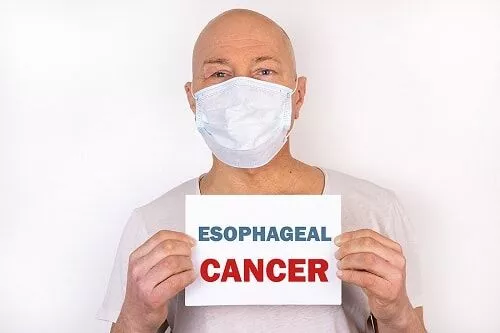
    How Esophageal Cancer Has Impacted 9/11 Survivors and Responders

    The attacks on September 11th caused 70+ different cancers, including a growing number of cases of esophageal cancer.  Scientific evidence supports the connection that even decades later, 9/11 exposure is associated with increased risks of esophageal cancer compared with the general population. It’s important to understand that the Victim Compensation Fund does not require you to prove that 9/11 exposure resulted in your cancer, but that there is a “presumed link” so long as you prove you were present at a qualifying exposure site during the eligible time period and have a certified 9/11-related condition, such as esophageal cancer. 

    For anyone who lived, worked, attended school, childcare, or adult care, or participated in rescue and recovery efforts in Lower Manhattan and the vicinity, a diagnosis of esophageal cancer raises the question: Was my 9/11 exposure the cause?  Now, nearly 25 years after September 11th, we know the link between esophageal cancer and the toxic air in lower Manhattan from 9/11 until mid-2002.  If you lived, worked, or went to school in lower Manhattan and were diagnosed with cancer since 9/11, you may qualify for lifetime health coverage and care from the World Trade Center Health Program and a cash award from the September 11th Victim Compensation Fund (VCF).

    Read More

    National Cancer Prevention and Early Detection Month Reminder: Lifetime Healthcare for Downtown Residents and Workers

    For the 9/11 downtown workers and residents, National Cancer Prevention and Early Detection Month serves as a reminder of the lifetime health benefits offered by the World Trade Center Health Program. Enrolling in the Health Program allows you to receive ongoing monitoring and stay proactive about your health. In the event you are diagnosed with a 9/11-related cancer, certification of this cancer by the Health Program provides access to specialized monitoring and treatment, and is the first step in seeking financial compensation for related losses.

    If you lived, worked, or attended school, or were a first or general responder, anywhere within 1.5 miles of the WTC site, enrolling in the WTC Health Program is a key step to protecting both your health and your legal rights.  The 9/11 exposure zone may be bigger than you think, including the Financial District, Tribeca, Battery Park, Chinatown, South Street Seaport, One Liberty Plaza, the Deutsche Bank Building at 130 Liberty Street, 55 Water Street, and 1 Police Plaza, the Federal Buildings including 26 Federal Plaza and 290 Broadway, Borough Hall and other NYC building, all the downtown courts (state and federal) and the schools including Stuyvesant High School, PS 234, PS 89, and Borough of Manhattan Community College (BMCC), and Pace University.

    Read More

    The 9/11 Community Has an Increased Cancer Risk and Need for Early Cancer Detection

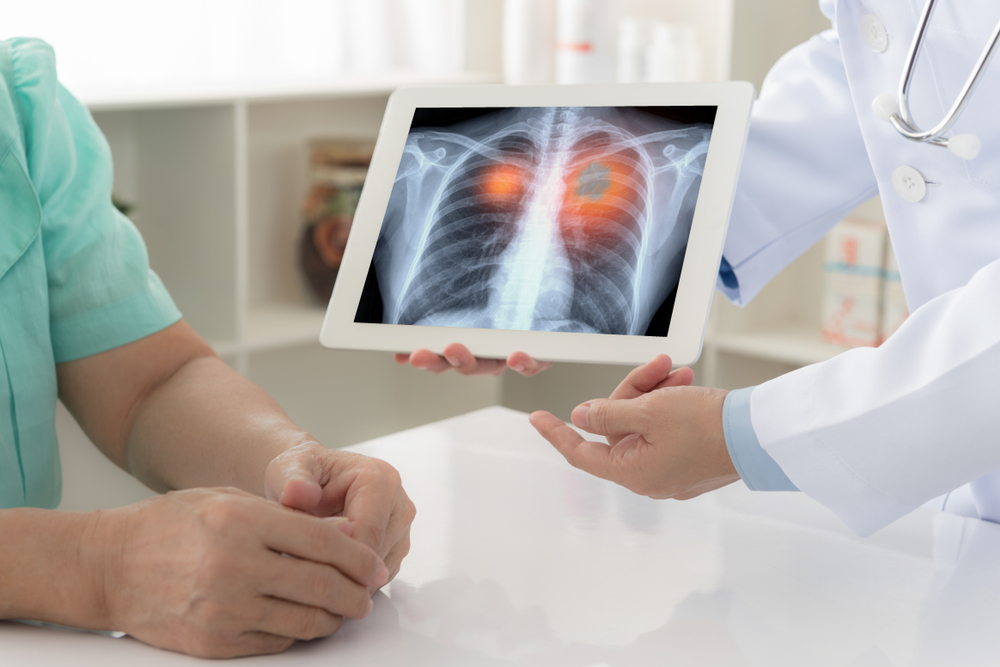
    The 9/11 community has an increased risk of developing cancer, even 25 years later. Advancements in early cancer detection are offering new hope for those who were exposed to the toxic 9/11 dust, making it possible to identify cancers sooner, improve treatment outcomes, and expand access to critical health care and compensation benefits. With most 9/11-related cancers taking a long time to develop, cancer detection has become one of the most important tools for protecting long-term health. 

    Read More

    Does it Matter How Long I was in Lower Manhattan on or After 9/11 for me to get 9/11 Health Program Benefits or a VCF Payout?

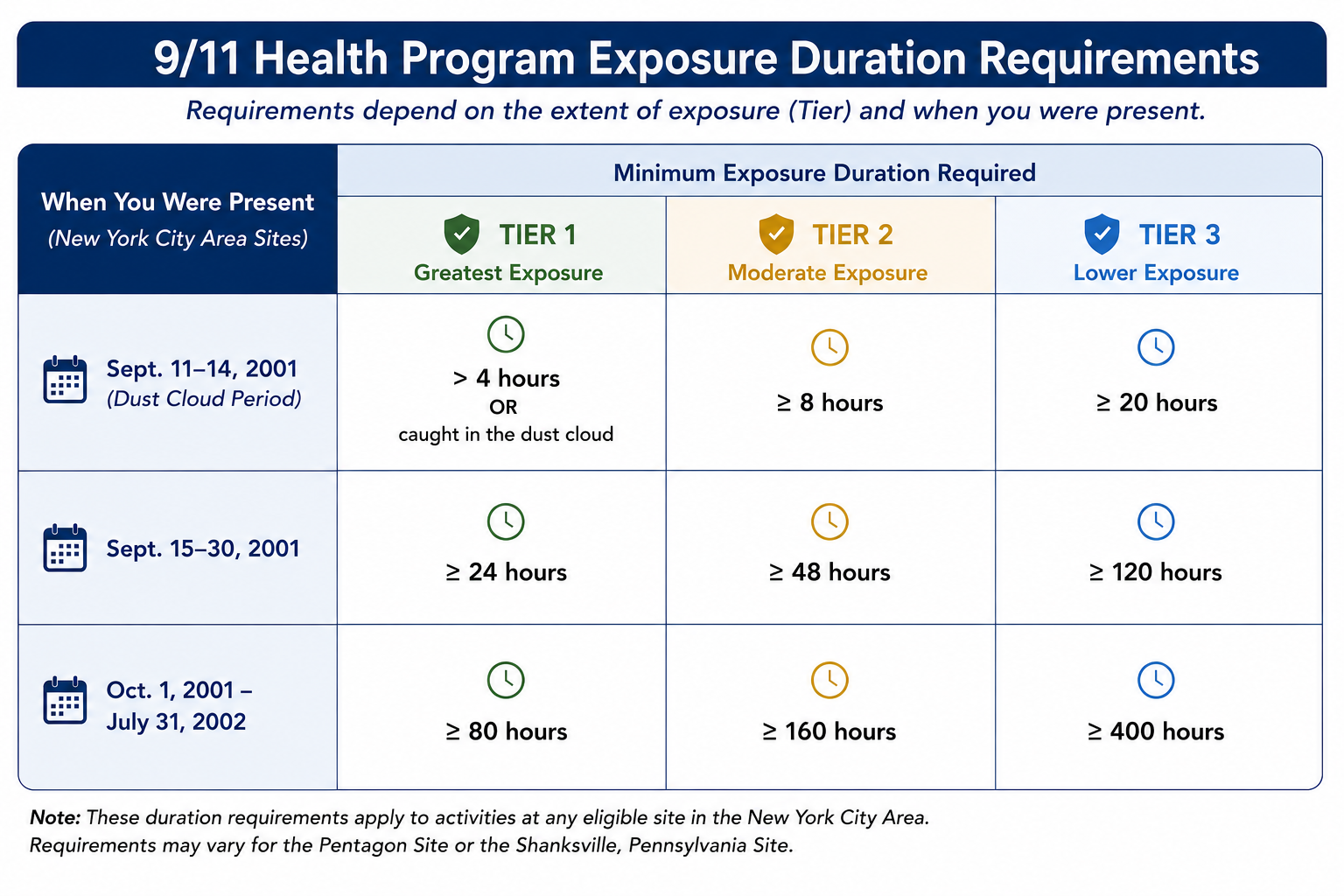
    New clients often ask the same question: how long do you need to be in lower Manhattan on or after 9/11 to qualify for 9/11 health benefits and compensation? The September 11th Victim Compensation Fund (VCF), the federal program that pays 9/11 victim compensation, does NOT have a minimum duration of time period requirement. The World Trade Center Health Program (WTC Health Program), the corresponding federal program that certifies if a cancer or other condition is 9/11-related and provides healthcare for the related condition, has a list of specific rules regarding duration of exposure to the 9/11 toxins. Most importantly, to be eligible for 9/11 VCF compensation, a claimant must first satisfy the requirements of the WTC Health Program and have their cancer or other condition certified as 9/11-related. So while the VCF does not have its own duration of exposure requirement, the WTC Health Program does, and the duration of exposure rules must be met to later file a claim with the VCF. 

    This naturally leads to a second question: What are the duration of exposure requirements? The WTC Health Program rules provide charts that depend on the extent of exposure to the 9/11 dust, how long (the duration) you were exposed, and when (which date(s)) you were exposed. We have summarized these rules in the chart below:

    Read More

    Scholarships for Children of 9/11 First Responders

    Support is available for first responders and recovery workers who rushed to help when the Twin Towers fell on September 11, 2001. Firefighters, police officers, EMTs, construction workers, volunteers, and military service members who stepped forward during rescue and recovery efforts know how the sacrifices they made can affect their families as well as themselves. To honor their service, a number of organizations offer scholarships for children of 9/11 first responders, providing financial aid to help children of first responders pursue higher education at an accredited college or university, community college, or trade school.

    If you were a 9/11 first responder or are a child of a 9/11 first responder, exploring scholarship opportunities, understanding eligibility requirements, and application steps can help you get started on your journey to higher education.

    Read More

    How 9/11 Health Research Has Evolved Over the Last Two Decades

    More than 20 years after the September 11, 2001, terrorist attacks, the full effect of the health impacts is still being understood. As time passed, a health crisis began to emerge involving chronic illness, cancer, respiratory disease, digestive disorders, and long-term mental health conditions among 9/11 responders, victims, and others present in the aftermath of the attacks. 

    What began as short-term emergency response research has evolved into one of the most comprehensive public health monitoring efforts in the history of the United States. From early studies focused on dust exposure to ongoing cancer surveillance, 9/11 health research has informed the support available to the 9/11 community and has reshaped how the nation responds to environmental disaster and mass trauma.

    Read More

    Understanding the Link Between 9/11 Exposure and Multiple Myeloma

    Among the most serious conditions linked to toxic exposure in the aftermath of the terrorist attacks on the World Trade Center (WTC) is multiple myeloma, a rare but aggressive blood cancer that affects plasma cells.

    For many first responders, volunteers, office workers, residents, students, and others who were present in lower Manhattan on or after the attacks, a diagnosis of multiple myeloma is directly tied to exposure to the toxic dust that blanketed lower Manhattan and the surrounding areas released when the towers fell. 

    Could 9/11 exposure be the cause? What scientific evidence supports the connection? And what health care and compensation options are available? This guide explores what we know about the direct link between 9/11 exposure and multiple myeloma, who is at risk, and what medical treatment, support, and compensation are available.

    Read More

    What Can Be Used to Show Your Proof of Presence for the VCF

    One of the most important requirements when filing a claim with the 9/11 Victim Compensation Fund (VCF) is proving you were present in the NYC Exposure Zone between September 11, 2001 and May 30, 2002. This step, called proof of presence, is essential for establishing eligibility for compensation. The VCF cannot process your claim without documentation showing that you lived, worked, went to school, volunteered, responded, or were otherwise in the affected area during the months when toxic dust and debris contaminated lower Manhattan. Fortunately, there are several documents that can be used to show your proof of presence. Here, we explain what proof of presence is, who must provide it, what documents the VCF accepts, common challenges, and what you can do if you no longer have proof of presence records.

    Read More

    How Spouses and Children Can File a 9/11 VCF Claim on Behalf of Their Loved One

    When a responder, resident, or downtown office or other worker passes away (even if many years ago) or becomes too sick to complete their claim, a spouse, child, or other representative may file a VCF claim on their behalf. While it has been more than two decades since the terrorist attacks of September 11, 2001, thousands of families have lost loved ones to one of the 70+ types of 9/11-linked cancers. Many are also still managing the long-term health consequences their loved ones suffered due to toxic exposure in the NYC Exposure Zone. 

    The September 11th Victim Compensation Fund (VCF) has awarded more than $16 billion in compensation to over 70,000 individuals who have suffered from cancer or other health conditions, including payments to families of nearly 7,000 people who have since passed away after their exposure to toxins in New York City, at the Pentagon, and in Shanksville, Pennsylvania. Filing a VCF claim as a personal representative for an estate or someone who is incapacitated involves added complexity, including proving legal authority to proceed, gathering extensive documentation, and meeting strict VCF rules for the estate of the deceased or incapacitated victims. Here, we detail what surviving spouses, children, and other family members need to know to successfully file a VCF claim on behalf of a loved one.

    Read More

    Understanding the Legal Path for 9/11 Breast Cancer Victims

    Breast cancer is among the many conditions that are officially recognized as linked to the toxic exposure. In fact, it is the third most common cancer diagnosis among those present in the aftermath of the attacks, with nearly 4,000 individuals certified with 9/11-related breast cancer by the World Trade Center Health Program (WTCHP). These 9/11 breast cancer victims include first responders, cleanup workers, NYC residents, students, downtown civilian workers, and others who were present in Lower Manhattan or other 9/11 exposure zones at any time between 9/11 and May 30, 2002.

    Read More